
Hang art so its center sits 57 inches from the floor. That is the museum standard, it is based on average eye level, and it is the right answer on an empty wall. Above a sofa it leaves you with eleven inches of blank wall and a picture that looks like it is floating away from the furniture.
The fix is a different measurement entirely: four to six inches above the back of the sofa, which for a standard 34-inch sofa back and a 24-inch picture puts the center at about 52 inches rather than 57. Here is the arithmetic for both, the spacing numbers for a group, and what your wall will actually hold.
The 57-inch rule, and the step people skip
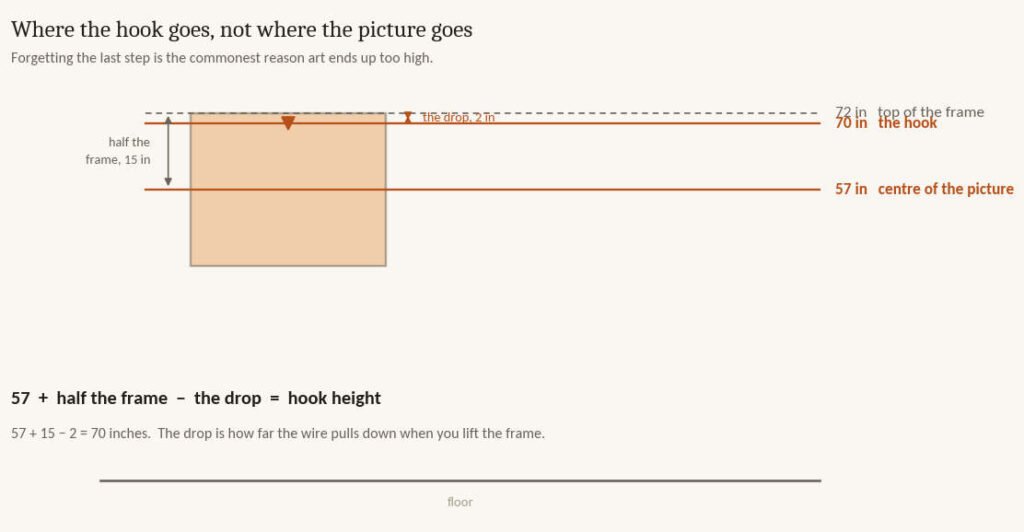
Fifty-seven inches is the average human sightline, which is why galleries center work there. The number refers to the center of the picture, and that is where most people go wrong, because they measure 57 inches up the wall and put the hook at that mark. The picture then hangs with its center well below eye level.
There are two steps, and the second is the one that gets forgotten.
- Find the top of the frame. Add half the frame’s height to 57. A 30-inch-tall frame gives 57 + 15 = 72 inches.
- Subtract the drop. The drop is how far the wire or hanger pulls down from the top of the frame when you lift it. If that is 2 inches, the hook goes at 70.
Measure the drop with the frame in your hands rather than guessing it. Pull the wire taut toward the top of the frame as though it were hanging, and measure from the top edge down to the wire. A slack wire on a heavy frame can drop three or four inches, and three or four inches is the difference between right and visibly wrong.
Above a sofa, the rule breaks
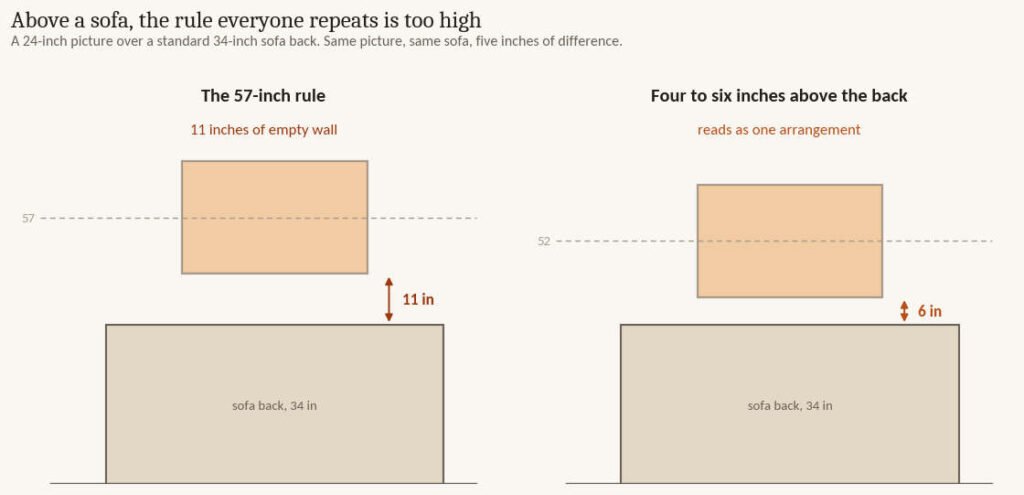
The 57-inch rule assumes an empty wall. Put a sofa under it and a second relationship starts to matter more than eye level: the gap between the furniture and the art.
The working number is four to six inches between the top of the sofa back and the bottom of the frame. Any more and the two stop reading as one arrangement. Run the arithmetic on a standard sofa, which stands 34 inches at the back, and a 24-inch-tall picture. Centered at 57 inches, the bottom of the frame lands at 45 inches, which is eleven inches of empty wall. Drop the center to 52 and the gap becomes six.
The same logic applies over a console, a headboard, or a fireplace. Whenever furniture sits below the art, the furniture sets the height and the 57-inch rule steps aside.
One more proportion worth having: the art should span roughly two thirds of the width of the furniture beneath it. A 62-inch sofa wants something around 40 inches wide, whether that is one piece or a group behaving as one.
Gallery walls: the spacing numbers
A group of frames succeeds or fails on whether the gaps look deliberate. The eye is very good at spotting an inconsistent gap and very bad at noticing whether the gap is two inches or three, which means consistency matters more than the exact figure.
| Frame size | Gap between frames | Notes |
|---|---|---|
| Up to 8 × 10 in | 1.5–2 in | Tighter gaps suit small work. |
| 11 × 14 to 16 × 20 in | 2–3 in | The standard range. |
| 18 × 24 in and larger | 3–4 in | Bigger frames need more air. |
| Mixed sizes | Pick one gap, about 2.5 in | Hold it everywhere. This is the whole trick. |
Spacing between frames in a group.
Treat the whole cluster as a single rectangle and center that rectangle at 57 inches, or four to six inches above the furniture if there is any. Leave four to six inches between the cluster and anything large beside it, a television in particular.
Before drilling anything, cut kraft paper to the size of every frame, tape the templates to the wall and live with them for a day. It costs nothing, it is the only way to see the arrangement at full size, and it is far cheaper than filling holes.
What the wall will actually hold
Most people hang art on whatever hook was in the drawer and find out the hard way. The fastener, not the wall, is what fails.
| Fastener | Rated capacity | When to use it |
|---|---|---|
| Bare nail or screw, no anchor | 5–10 lb | Small unframed work only. This is what fails. |
| Picture hook with angled nail | 10–50 lb | Most framed prints. Check the rating on the packet. |
| Plastic expansion anchor | 10–25 lb | Light mirrors and small frames. |
| Threaded self-drilling anchor | 25–50 lb | The sensible default for anything substantial. |
| Toggle bolt | 50–100+ lb | Heavy mirrors, large framed glass, no stud available. |
| Screw into a stud | 80–100+ lb | Always the best option if a stud is where you need it. |
Weight capacity by fastener in standard half-inch drywall.
Those printed ratings are best-case laboratory numbers, measured in fresh half-inch drywall under a straight downward pull. Real walls have been drilled before, and real frames swing when a door slams. Halve the rated figure and you will be about right.
Weigh the piece rather than estimating it. A framed poster feels light and a 24 by 36 print behind glass in a wood frame can pass fifteen pounds, which takes it past a plain nail and most plastic anchors.
Where this advice doesn’t apply
Tall rooms change the sightline. In a room with ten or twelve foot ceilings, 57 inches can look low, and the honest answer is to hang a little higher and accept that you are deviating from the standard for a reason.
Staircases have no fixed eye level, because the viewer’s height changes with every step. Follow the line of the stair rather than a single height, keeping each piece the same distance above the nosing of the step below it.
Rented walls are worth a mention. Adhesive strips rated for the weight avoid holes entirely, and they are genuinely fine for work under about eight pounds. Above that they fail, usually at three in the morning.
And if the piece is going above a radiator or a working fireplace, heat and soot will reach it. That is a conservation question rather than a hanging one, and the answer is usually to hang something you do not mind losing.
Questions people ask about hanging art
How high should art be above a sofa?
Four to six inches between the top of the sofa back and the bottom of the frame. On a standard 34-inch sofa back that puts the bottom of the frame at 38 to 40 inches, and for a 24-inch-tall picture the center lands around 52 inches rather than the usual 57. The gap matters more than the eye-level rule, because the two objects need to read as one arrangement.
What is the 57-inch rule?
Hang art so the center of the picture sits 57 inches from the floor, which is the average human sightline and the standard most galleries work to. The number refers to the center of the artwork, not the hook. To find the hook, add half the frame height to 57, then subtract the drop of the wire. For a 30-inch frame with a 2-inch drop, the hook goes at 70 inches.
How much space should there be between pictures?
Two to three inches for standard frames, tightening to an inch and a half for small work and opening to three or four for large pieces. On a wall that mixes sizes, choose one gap of about two and a half inches and hold it everywhere. An inconsistent gap reads as a mistake; a slightly unusual but consistent one reads as a decision.
How much weight can drywall hold without a stud?
A bare nail holds 5 to 10 pounds, a plastic anchor 10 to 25, a threaded self-drilling anchor 25 to 50, and a toggle bolt 50 to 100 or more. Those are best-case figures from fresh drywall, so halve them in a real wall. If the piece is heavy and a stud is anywhere near where you want it, use the stud.




Post a comment