

The gap between a $1,500 sofa and a $4,000 one comes down to five specifications, and one of them predicts more than the other four together. Seat foam at 1.5 pounds per cubic foot flattens in two to five years. At 2.5 pounds it holds its shape for eight to fifteen.
That number is almost never on the tag, it costs nothing to ask for, and a salesperson who cannot find it out has told you the answer. Here is the whole comparison, spec by spec, and the point at which paying more stops making sense.
The five specs, and what each price usually buys
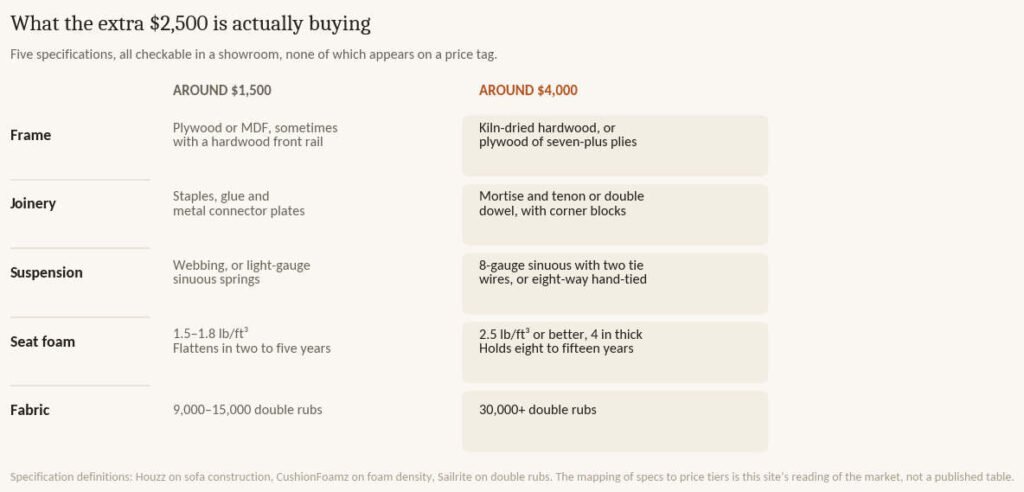
Nothing in that table is exotic and nothing in it is hidden. All five can be established in a showroom in about four minutes by asking, and the reason most people do not ask is that furniture is sold on how it looks and how it feels to sit on for ninety seconds, both of which are identical across the price range on day one.
A note on where those tiers come from. The specification definitions are published by the trade. The mapping of specs to price is this site reading the market rather than a table anyone prints, so treat $1,500 and $4,000 as shorthand for two ends of a range rather than as thresholds.
The one number that predicts how long you will like it
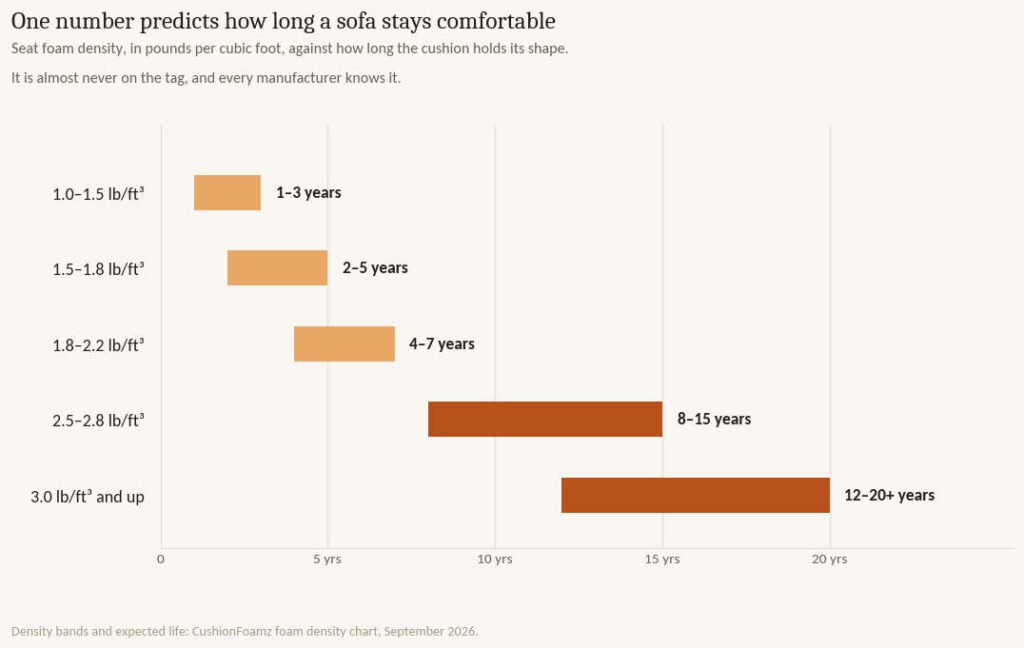
Foam is graded by density, measured in pounds per cubic foot, and density is a direct measure of how much material is in there to compress. Low-density foam at 1.0 to 1.5 pounds gives one to three years. The 1.5 to 1.8 band, which is where a great deal of mid-market seating sits, gives two to five. At 1.8 to 2.2 you are looking at four to seven years, at 2.5 to 2.8 it is eight to fifteen, and above 3.0 pounds the foam outlives most people’s interest in the sofa.
Density is not firmness, and confusing the two is how people end up disappointed. Firmness is measured separately, as ILD, and a sofa can be soft and dense at the same time. Everyday seating sits around 25 to 35 ILD and a firmer daily-use sofa around 35 to 45. Density tells you how long it lasts. ILD tells you how it feels. A cheap sofa often feels wonderful in the showroom precisely because soft low-density foam has not been sat on yet.
Seat cushions should also have a foam core at least four inches thick. Thin foam over a plywood deck compresses to nothing regardless of density.
There is one piece of good news buried here. Foam is the one component you can replace. Restuffing cushions runs $100 to $1,200 depending on the sofa, and individual cushions reupholstered run $200 to $500 each. If the rest of the sofa is sound, a flattened seat is a repair rather than a replacement.
The frame decides whether the sofa gets a second life
Kiln-dried hardwood is the specification worth paying for, or engineered hardwood built up from at least seven plies. What to avoid is MDF, particleboard and thin plywood, and what to avoid even more is a frame held together with staples, glue and metal connector plates. The joinery to ask for is mortise and tenon or double dowel, with blocks glued and screwed into the corners.
The reason this matters is not that a stapled frame collapses. Most do not. It is that a stapled frame cannot be taken apart and put back together, which means the sofa has exactly one life.
Reupholstering a loveseat or a small sofa costs $600 to $2,000, and a large sofa or sectional $2,000 to $4,000, against a national average of about $2,300. The work takes five to twenty-five hours at $40 to $100 an hour and uses 5 to 18 yards of fabric on a small sofa or 18 to 36 on a large one, with fabric at $10 to $100 a yard. Seat spring replacement, if it comes to that, is $220 to $400.
So a hardwood-framed sofa is not a fifteen-year purchase. It is a fifteen-year purchase with an option to buy another fifteen for roughly half the original price. A stapled frame has no such option at any price, because no upholsterer wants the job and the frame will not survive being stripped.
Eight-way hand-tied is oversold
It is the phrase every showroom leads with and it is genuinely good construction: coil springs sitting on webbing, each one tied by hand in eight directions. It is also the most expensive suspension to build, which is why it is the one that gets advertised.
Sinuous springs, the S-shaped wires that run front to back, are what most sofas under about $2,500 use, and done properly they are fine. Properly means at least 8-gauge wire with a minimum of two silent tie wires running across and clipped to every spring. That is a specification you can ask for and, with the dust cover off, see.
What you should not accept in a seat is webbing alone. Rubber or fabric straps with nothing under them is the lowest-cost suspension there is, and it belongs in a back cushion rather than under anyone’s weight.
The position, stated plainly: spend the money on foam density and frame before you spend it on hand-tied springs. A hand-tied sofa with 1.8 pound foam will disappoint you sooner than a sinuous-sprung one with 2.5 pound foam, and it will cost more.
Fabric, and what double rubs do not tell you
Upholstery fabric is rated by abrasion resistance, tested by rubbing cotton back and forth across it. One back-and-forth is a double rub, and the test runs in sets of 5,000 until the fabric shows noticeable wear or two yarns break.
| Rating | Double rubs | What it suits |
|---|---|---|
| Delicate | Under 3,000 | Decorative use only. |
| Light duty | 3,000–9,000 | Formal rooms, occasional use. |
| Medium duty | 9,000–15,000 | Living and family rooms. |
| Heavy duty | 30,000+ | Living rooms and heavily used spaces. |
| Commercial minimum | 15,000 | The floor for contract upholstery. |
Wyzenbeek double rub ratings and their intended use.
Two cautions. The first is that there is a second test, Martindale, which rubs in a figure-eight rather than a straight line, and the two do not correlate. A Martindale figure and a Wyzenbeek figure are different measurements of different things and cannot be compared, so a high number from an unnamed test means very little.
The second is that abrasion is not the way most sofa fabric actually fails in a house. Pilling, sun fading along one arm, and the stain nobody got to in time are all more common than a fabric wearing through. Double rubs are worth checking and they are not the whole answer.
What it costs per year, and when paying more stops making sense
A quality fabric sofa lasts seven to fifteen years. Take the top of that, add one reupholstery at the $2,300 average, and a $4,000 sofa is around $250 a year across twenty-five years. A $1,500 sofa whose foam gives out at year five is about $300 a year. On that arithmetic the expensive sofa wins, comfortably.
The arithmetic has one large assumption in it, which is that you still want the sofa in year fifteen. Rooms change, houses change, and the honest thing to say about a twenty-five-year plan for a piece of furniture is that most people do not have one.
Which makes the cheap sofa a legitimate answer in specific situations rather than a mistake. A first apartment, a rental you know you will leave, a room whose layout is not settled, a household with a toddler and a dog: all of these are five-year decisions, and paying $4,000 to solve a five-year problem is its own kind of waste.
The buy worth thinking hardest about is the middle. Given $2,500, a sofa with a proper hardwood frame and unremarkable foam beats one with a stapled frame and good foam every time, because the foam can be replaced later and the frame cannot. Spend on the part that is permanent.
Where this advice doesn’t apply
Leather changes the numbers. A quality leather sofa can last around three times as long as a fabric one, which moves the whole calculation, and none of the double rub material applies to it.
Sofa beds are a different product with a different failure mode. The mechanism is what gives out, the frame is built around it, and the specifications above are secondary to how the folding hardware is made.
Anything you plan to keep for a long time in a house with direct sun on it needs a fade conversation rather than an abrasion one. A south-facing window will take the color out of one arm of a sofa long before anyone wears the fabric through.
And if the sofa has to come up a stairwell or through a narrow door, measure before you specify any of this. The best-built sofa in the store is worthless if it stops on the landing.
Questions people ask about sofa quality
What foam density should a sofa cushion be?
2.5 pounds per cubic foot or higher for a seat you want to keep, in a core at least four inches thick. That band holds its shape for eight to fifteen years. Foam at 1.5 to 1.8 pounds, which is common in mid-market sofas, flattens in two to five. Density is a separate measurement from firmness, so a dense cushion can still be soft: ask for both numbers, because density predicts life and ILD predicts feel.
Are eight-way hand-tied springs worth it?
They are excellent construction and they are not where the money is best spent first. Sinuous springs in at least 8-gauge wire, with two tie wires clipped across every spring, perform well in a normal household. Foam density and frame construction have a larger effect on how long the sofa stays good, so put the budget there before paying for hand-tied coils. What is genuinely worth avoiding is webbing alone under a seat.
How long should a sofa last?
Seven to fifteen years for a quality fabric sofa, and roughly three times that for good leather. The usual limit is not the frame but the seat foam, which is why low-density foam brings the whole number down to two to five years. Fraying, creaking, and the feeling of sinking in when you sit down are the three signs that it has reached the end.
Is it worth reupholstering a sofa instead of buying new?
It depends entirely on the frame. On kiln-dried hardwood with proper joinery, yes: $600 to $2,000 for a small sofa or $2,000 to $4,000 for a large one buys another decade and change, against a $2,300 national average. On a stapled MDF frame, no, and most upholsterers will decline the work, because the frame will not survive being stripped and rebuilt.




Post a comment