

A paver patio costs $8 to $25 per square foot installed, which works out at about $3,800 for the average 280 square foot patio. The number that decides whether it is still flat in ten years is not on any quote: the compacted base underneath, which should be four to six inches of angular crushed stone for a patio and eight to twelve for a driveway.
Everything visible on a finished patio is the top three inches. Everything that determines how it ages is the seven inches under that, and it is the easiest part of the job to cut because nobody can inspect it afterward.
What a patio costs
| Size | Installed cost | Notes |
|---|---|---|
| 100 sq ft | $800–$2,500 | A small sitting area, roughly 10 × 10. |
| 280 sq ft | $2,240–$7,000 | The national average patio. Average spend about $3,800. |
| 400 sq ft | $3,200–$10,000 | Dining plus seating, 20 × 20. |
US installed costs, September 2026. The wide ranges are mostly material and access rather than labor.
Material accounts for most of the spread. Concrete pavers run $8 to $15 per square foot, brick and clay $10 to $20, and natural stone $15 to $50, with premium stone pushing past that. Labor is $50 to $80 an hour, or $4 to $11 per square foot when quoted that way.
Two smaller lines worth knowing before they surprise you. Sealing costs around $200 for up to 1,000 square feet, and drainage materials add $0.10 to $1 per square foot depending on what the site needs. Neither is large, and both get left off cheap quotes.
The layers, and the two that go wrong
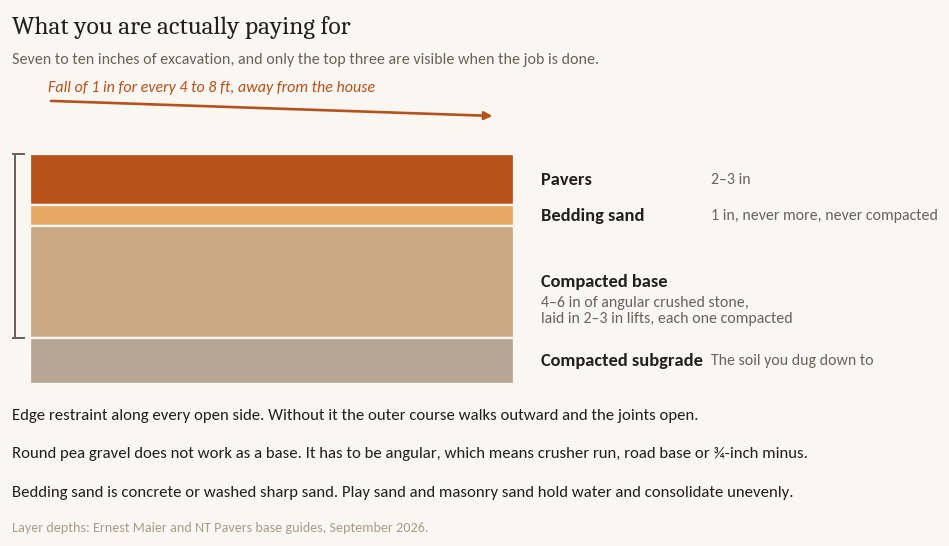
A patio is four layers and two of them are routinely built wrong.
The base is the first. It has to be angular crushed stone, sold as crusher run, road base or three-quarter-inch minus, because angular pieces lock against each other under load. Round pea gravel does not lock, it rolls, and a patio built on it moves. The base also has to go in as layers of two to three inches with a plate compactor run over each one before the next goes down. Tipping six inches of stone in and compacting the top of it produces a compacted crust over a loose six inches, which is not the same thing and fails the same way an uncompacted base does.
The bedding sand is the second, and this is the one that catches almost every do-it-yourself patio. It is one inch. Screeded flat, left loose, never compacted before the pavers go on, and never thicker than an inch. Sand is tempting because it is easy to work with and it hides an uneven base, which is exactly why people use two or three inches of it to level things out. Thick sand consolidates under load, unevenly, and the patio develops the low spots and rocking pavers that people blame on settling ground.
The sand also has to be the right sand. Concrete sand or washed sharp sand, which drains and stays put. Play sand and masonry sand hold moisture and compress unevenly, and they are the two most likely bags to be sitting by the register at a hardware store.
The fourth thing that is not a layer at all is edge restraint, which is the plastic or metal channel spiked into the base around every open side. Without it the outer course walks outward under traffic, the joints open up behind it, and the failure moves inward from the edge. It is a cheap component and its absence is one of the clearer signs of a rushed job.
How deep the base has to be
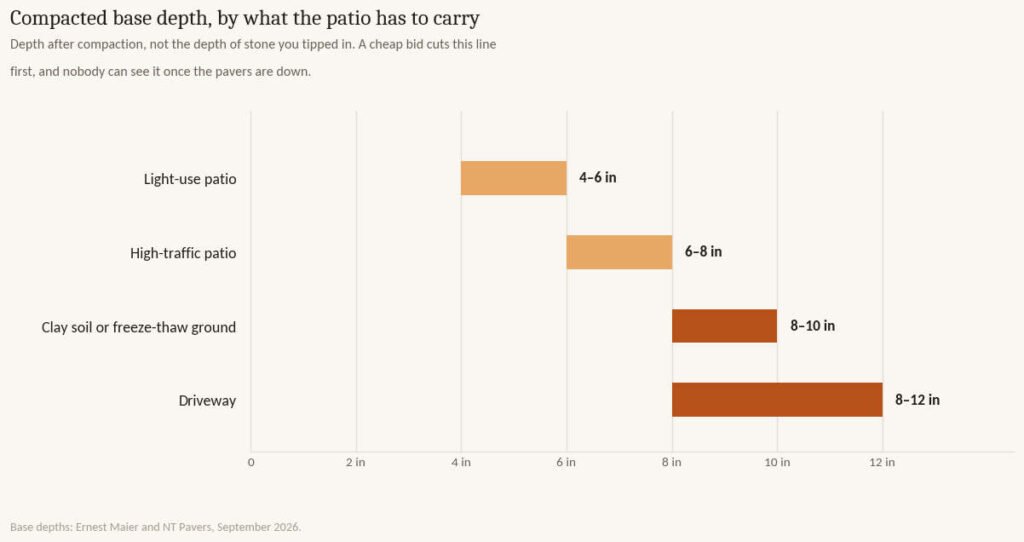
Four to six inches of compacted base is the figure for a normal patio. A patio that takes heavy furniture, a hot tub or constant traffic wants six to eight. A driveway wants eight to twelve, and there is no version of a driveway where a patio base is adequate.
Two ground conditions push the number up regardless of use. Clay soil holds water and moves with it, and ground that freezes and thaws heaves whatever sits on it, so both push the base to eight inches or more. If the subgrade itself is soft, the usual remedy is to dig two inches deeper than planned and fill that with compacted stone rather than trying to compact the soft soil into behaving.
One detail that separates a real specification from a sales one: these depths are after compaction. Stone loses volume as it is compacted, so six inches of compacted base is not six inches of stone delivered. A contractor who quotes base depth in inches of material rather than inches of compacted base has either not thought about it or is hoping you have not.
What the dig actually involves
Add the layers up and a patio is seven to ten inches of excavation. Pavers at two to three inches, bedding sand at one, and base at four to six.
On a 280 square foot patio dug to eight inches, that is roughly seven cubic yards of soil coming out, and about four and a half cubic yards of crushed stone going back in. Seven cubic yards of soil is a pile the size of a small car sitting on the lawn, and getting rid of it is a real line item that quotes handle very differently from one another. Ask where the spoil goes.
The other thing the dig has to get right is the fall. The finished surface needs to drop about one inch for every four to eight feet of run, away from the house. It is a slope you can barely see and cannot skip, and getting it backward puts water against a foundation, which is a far more expensive problem than an uneven patio.
Before anyone digs anything, call 811 and have the utilities marked. It is free, it takes a few days, and eight inches is deep enough to find things.
How to read two quotes that are $3,000 apart
On the same three hundred square feet, with the same pavers, a $3,000 gap between two bids is almost never the pavers. It is the base, the disposal and the edge restraint, and those three are invisible in a finished photograph.
Four questions settle it, and they take a minute.
- How many inches of compacted base, and what stone? You want a number and the words crusher run, road base or three-quarter minus.
- In how many lifts, and compacted with what? Two to three inch lifts, plate compactor on each.
- How thick is the bedding sand, and which sand? One inch, concrete or washed sharp sand.
- Is edge restraint included, and where does the spoil go?
The contractor who answers all four without hesitating is the one to hire, and it does not much matter whether they are the cheaper of the two. The one who says the base depends on the site and moves on has told you what the base will be.
Where this advice doesn’t apply
Anything holding back soil is a different job. A patio cut into a slope needs a retaining wall, retaining walls above a certain height are engineered structures in most jurisdictions, and that is a licensed contractor’s work rather than a weekend’s. Do not treat wall block as large pavers.
Patios that meet the house need care about height. The finished surface has to sit low enough to keep water and splash away from siding and any weep screed, and building a patio up to the level of a door threshold is a common and expensive mistake.
Mature trees complicate everything. Excavating eight inches through a root plate damages the tree and the roots will eventually move the patio anyway, so a patio near an established tree wants a conversation with an arborist before a quote from a landscaper.
And in a small courtyard with no access for machinery, the arithmetic changes because everything moves by wheelbarrow. Labor rises, the stone gets more expensive to place than to buy, and a contractor quoting the same per-square-foot rate as an open backyard has not visited the site.
Questions people ask about paver patios
How deep should a paver patio base be?
Four to six inches of compacted angular crushed stone for a normal patio, six to eight for heavy use, and eight to twelve for a driveway. Clay soil or a freeze-thaw climate pushes it to eight or more. Those figures are the depth after compaction, not the depth of loose stone, and the base has to go in as two to three inch lifts with each one compacted before the next.
How much sand goes under pavers?
One inch of concrete sand or washed sharp sand, screeded level and left loose. Never more than an inch, and never compacted before the pavers go down. Thicker sand is the single most common reason a home-built patio develops low spots and rocking pavers, because a deep sand layer consolidates unevenly under load in a way a properly compacted stone base does not.
How much does a 400 square foot paver patio cost?
$3,200 to $10,000 installed, at a typical $8 to $25 per square foot. Concrete pavers sit at the bottom of that range at $8 to $15 per square foot, brick and clay at $10 to $20, and natural stone at $15 to $50. Labor is $4 to $11 per square foot of it. Add roughly $200 if you want it sealed.
Why is my paver patio sinking?
Usually one of three things, and all three happened before the pavers went down. The base was too shallow or was not compacted in layers. The bedding sand was thicker than an inch and has consolidated unevenly. Or there is no edge restraint, so the outer course has moved outward and the joints behind it have opened. Lifting and relaying the affected area is the fix, and it means correcting the layer underneath rather than adding sand.




Post a comment