
A 12 by 14 foot bedroom with 9 foot ceilings takes about 2.1 gallons of wall paint for two coats, which means you buy three. A gallon covers 350 to 400 square feet. Primer covers 200 to 300, and that gap is the single most common reason a job stops halfway through a Saturday.
The arithmetic is five steps and takes two minutes. The part worth more than the arithmetic is what happens when you get it wrong and go back for one more can.
The arithmetic
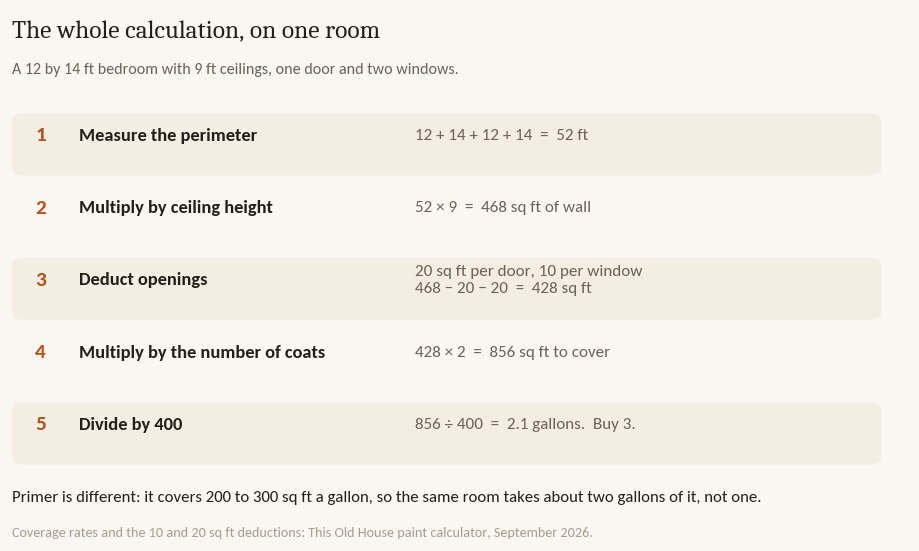
Measure the perimeter of the room, multiply it by the ceiling height, take off 20 square feet for every door and 10 for every window, multiply by the number of coats, and divide by 400.
Two of those steps get skipped. People forget to multiply by the number of coats, which halves the answer, and people measure the ceiling height at eight feet because that is what ceilings are, when a great many rooms built since the 1990s are nine or ten.
Ceilings and trim are separate sums and both are small. A ceiling is length times width divided by 400, and it usually takes one coat rather than two, so the room above needs about half a gallon. Trim comes in well under a gallon in any normal room, and the gallon is the smallest sensible unit to buy anyway.
What each room size takes
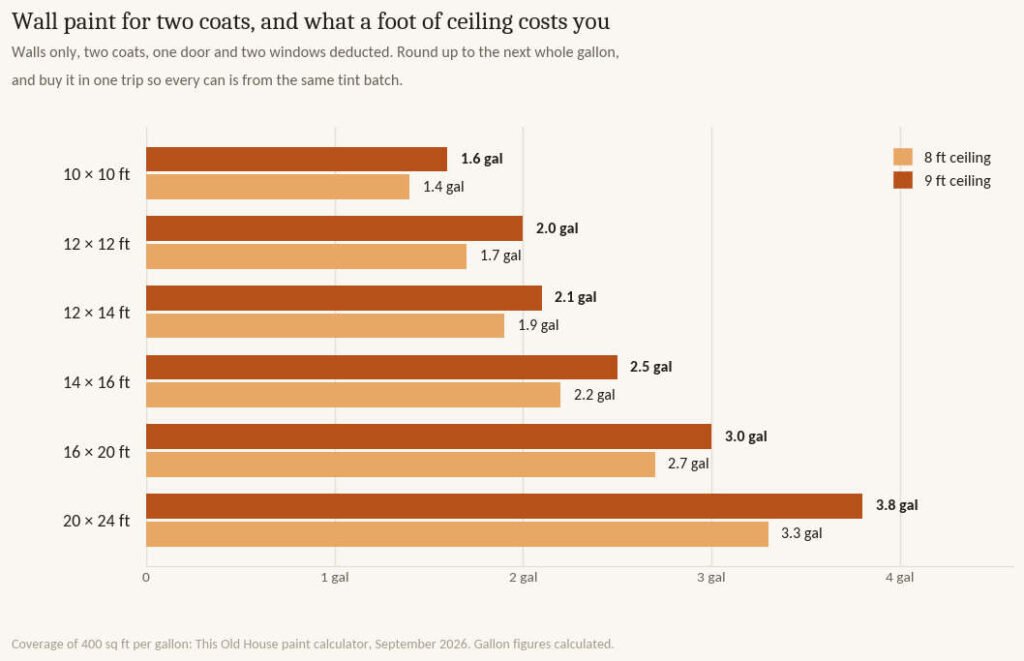
The chart is walls only, two coats, with one door and two windows taken off. Look at what a single foot of ceiling height does: the same 20 by 24 foot room needs 3.3 gallons at eight feet and 3.8 at nine. That extra foot is half a gallon, and half a gallon is the difference between buying three and buying four.
| Room, walls only | 8 ft ceiling | 9 ft ceiling |
|---|---|---|
| 10 × 10 ft | 1.4 gal | 1.6 gal |
| 12 × 12 ft | 1.7 gal | 2.0 gal |
| 12 × 14 ft | 1.9 gal | 2.1 gal |
| 14 × 16 ft | 2.2 gal | 2.5 gal |
| 16 × 20 ft | 2.7 gal | 3.0 gal |
| 20 × 24 ft | 3.3 gal | 3.8 gal |
Wall paint for two coats, one door and two windows deducted, at 400 sq ft per gallon. Round up to the next whole gallon.
Round up, always. The fractional gallon you are tempted to skip is the one you need at four in the afternoon when the second coat turns out to be thinner than the first over a patched wall.
Primer is a different number
Primer covers 200 to 300 square feet a gallon, not 350 to 400. On the 12 by 14 room, 428 square feet of wall needs about two gallons of primer against about three gallons of paint for two coats. Anyone who buys primer and paint in equal quantities has bought too little primer.
| Product | Coverage per gallon |
|---|---|
| Interior paint, one coat | 350–400 sq ft |
| Interior paint, one quart | About 100 sq ft |
| Primer | 200–300 sq ft |
| Any of the above on bare drywall, plaster or stucco | Less. Prime it rather than buying more paint. |
Coverage rates, September 2026. All assume a smooth, sealed surface.
Whether you need it at all depends on what is underneath. New drywall and any bare or patched surface wants it, because those surfaces drink paint at a rate that makes the coverage figure meaningless. Repainting a sound wall in a similar color does not. Going from a deep color to a pale one is the case where primer genuinely saves money, because a tinted primer costs less than the extra coat of finish paint it replaces.
Paint-and-primer-in-one products run $35 to $65 a gallon against $20 to $60 for ordinary interior paint. They are real paint with more solids in them, and they work on a sound previously painted wall. They are not a substitute for a dedicated primer on bare drywall, a stain, or anything glossy.
Buy it in one trip, and mix the cans together
This is the part that costs people a wall rather than a few dollars. Tinted paint is mixed to order and there is variation between batches. Two gallons of the same color, tinted on different days from different base cans, can be slightly different, and the difference is invisible in the can and obvious on a wall in daylight.
Buying everything in one go from one store, at one time, keeps you in one batch. Painters then go one step further and pour all the gallons into a single five-gallon bucket, stir, and work out of that. The trade calls it boxing, and what it does is average any variation across the whole job rather than leaving it as a line down the middle of a wall.
It also solves the more common version of the problem, which is running short and buying one more gallon a week later. That gallon is a different batch by definition, and it lands on the last wall you paint, which tends to be the one behind the door and the one you notice from the bed.
What it costs, and where the money actually goes
Interior paint runs $20 to $60 a gallon, paint with primer built in $35 to $65, and primer $20 to $75. A five-gallon bucket is $75 to $300. On the 12 by 14 bedroom, three gallons of wall paint, one of ceiling paint and two of primer come to roughly $165 to $405 in materials.
Now the number that reframes it. When a professional paints a room, labor is 70 to 80 percent of the bill. Painting labor runs $1 to $3 per square foot of surface covered, or $3 to $7 per square foot of floor area, which puts that bedroom somewhere around $500 to $1,200 all in.
So the difference between $25 paint and $55 paint on this room is about $90, against a total that is several hundred dollars either way. Choosing the cheaper paint to save $90 and then needing a third coat to cover is a bad trade even when you are doing the work yourself, because the thing you are actually spending is a day. On a job you are paying someone else to do, it is close to indefensible.
Where 400 square feet stops being true
The coverage figure on the can is measured on a smooth, sealed, primed surface. Rooms are not always that.
Porous surfaces absorb at a much higher rate. Unpainted drywall, stucco, bare plaster and anything freshly patched will take more paint than the arithmetic says, which is the argument for priming them rather than for buying a fourth gallon.
Texture is the other one, and it is a geometry problem rather than an absorption problem. A knockdown or orange-peel wall has more actual surface than the flat rectangle you measured, so the same measured area needs more paint to cover it. Heavy texture can push consumption up noticeably against a smooth wall of identical dimensions.
Deep saturated colors are the third case. Strongly tinted paints carry less white pigment, which is what does most of the hiding, so a deep red or a dark teal often needs three coats where an off-white needs two. If you are going dark, plan on three and be pleased if two does it.
Where this advice doesn’t apply
Ceilings in rooms with a lot of recessed lighting are worth measuring properly rather than treating as length times width, because the cut-in around fittings takes time rather than paint and the labor estimate is the one that moves.
Anything painted before 1978 in the United States may have lead paint under the surface, and sanding or scraping it is a job with rules attached. Test first and, if it is positive, get a certified contractor. This is not a case for working it out yourself.
Exterior work runs on different coverage entirely, because siding, brick and rough lumber all absorb far more than interior drywall, and the arithmetic above will understate it.
And in a rental, check what the lease says before you buy anything. Plenty of leases require a return to the original color at the end of the tenancy, which means the real cost of painting a wall is painting it twice.
Questions people ask about paint quantities
How much paint do I need for a 12 by 12 room?
About 1.7 gallons for two coats of wall paint with eight foot ceilings, or 2.0 gallons at nine feet, after deducting a door and two windows. Buy two gallons in the first case and three in the second, because the fractions never work in your favor. Add roughly half a gallon for one coat on the ceiling and up to a gallon for trim.
How many square feet does a gallon of paint cover?
350 to 400 square feet for one coat, and a quart covers about 100. Primer is different at 200 to 300 square feet a gallon. Those figures assume a smooth, sealed surface, so a textured wall, bare drywall or fresh patching will all take more. Divide your measured wall area by 400 for a planning number and round up.
Do I really need two coats?
On any color change, yes. One coat can be enough when you are painting the same color over itself on a sound wall, and that is about the only case. A deep saturated color often needs three, because heavily tinted paint carries less of the white pigment that does the covering. Plan for two, buy for two, and accept three if you are going dark.
Should I buy all the paint at once?
Yes, in one trip from one store. Tinted paint varies slightly between mixing batches, and a can bought a week later is a different batch by definition. The difference does not show in the can and does show on the wall. If you have several gallons, pour them into a five-gallon bucket and stir before you start, which spreads any variation across the whole room instead of concentrating it on one wall.




Post a comment