

Build a 16 by 20 foot deck in pressure-treated pine and ten years of it, upkeep included, costs about $10,400. The same deck in composite costs about $13,100. Composite is sold on the idea that the maintenance you skip pays back the higher price, and at ten years it has not. The break-even sits closer to year twenty.
There is a problem with waiting until year twenty, and it is sitting underneath both decks. The frame is pressure-treated lumber either way, its life expectancy is about fifteen years, and no composite warranty covers it.
The ten-year arithmetic
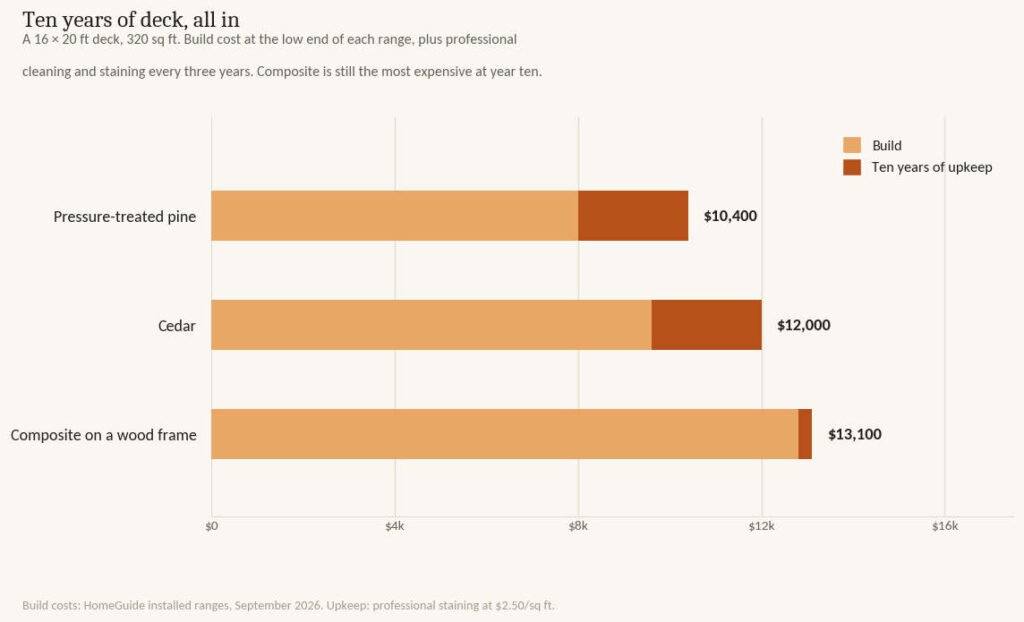
Take a 320 square foot deck, which is a common size and big enough to matter. Built at the low end of each material’s installed range, pressure-treated pine starts at about $8,000, cedar at $9,600 and composite at $12,800. That is a $4,800 gap on day one.
Then add the upkeep. A wood deck needs cleaning and a fresh coat of stain every two to three years. Have it done professionally at around $2.50 per square foot and each round costs $800. Three rounds across ten years is $2,400. Composite needs washing, and Trex, which sells the stuff, puts that at under $20 a year. Call it $200 to $400 over the decade to allow for a professional wash now and then.
So the ten-year totals land at $10,400 for pressure-treated, $12,000 for cedar and $13,100 for composite. Composite is still the most expensive, and it is still the most expensive if you carry the numbers out to year fifteen.
The one scenario where composite wins on cost
Change a single assumption and the picture shifts. Stain every two years instead of every three, which is what a deck in full sun or heavy rain actually needs, and wood needs five rounds rather than three. That is $4,000 of staining. Pressure-treated now totals $12,000 and cedar $13,600, which puts cedar above composite and pressure-treated within a thousand dollars of it.
Change the other assumption and it swings back hard. Do the staining yourself and the cost per round drops from $800 to about $240, because you are paying for stain rather than for two days of somebody’s labor. Ten years of DIY staining on a three-year cycle is $720. Pressure-treated finishes the decade at $8,720 against composite’s $13,000.
That is the honest summary of the composite argument. It is not a money decision, it is a time decision. What you are buying for the extra $4,800 is roughly four weekends of sanding and brushing over ten years, plus not having to think about it. For plenty of people that is worth $4,800. It is simply not the same claim as paying for itself.
What the upkeep actually involves
| Job | Cost | How often |
|---|---|---|
| Clean and stain, professional | $1.50–$4.00 / sq ft | Every 2–3 years |
| Clean and stain, DIY materials | $0.50–$1.00 / sq ft | Every 2–3 years |
| Power wash on its own | $0.35–$0.77 / sq ft | Yearly |
| Strip an old failing finish | $2.50–$5.50 / sq ft | When it flakes rather than fades |
| Seal a pressure-treated deck | $0.75–$4.00 / sq ft | Every 1–2 years |
| Wash a composite deck | Soap, water, an afternoon | Yearly |
Deck maintenance costs, September 2026. Railings are quoted separately at $4 to $8 per linear foot.
Two details in that table are worth more than the rest of it. The first is that stripping costs more than staining. A finish left until it peels has to come off before anything else goes on, and that single job can cost more than two ordinary stain rounds put together. Staining on schedule is cheaper than staining late.
The second is railings. They are priced per linear foot, not per square foot, and a 16 by 20 deck with railing on three sides carries 52 linear feet of it. At $4 to $8 that is $208 to $416 added to every single round, which quietly doubles the quote on a small deck. If you are comparing bids and one is much lower, check whether the railings are in it.
The part the quotes leave out: the frame
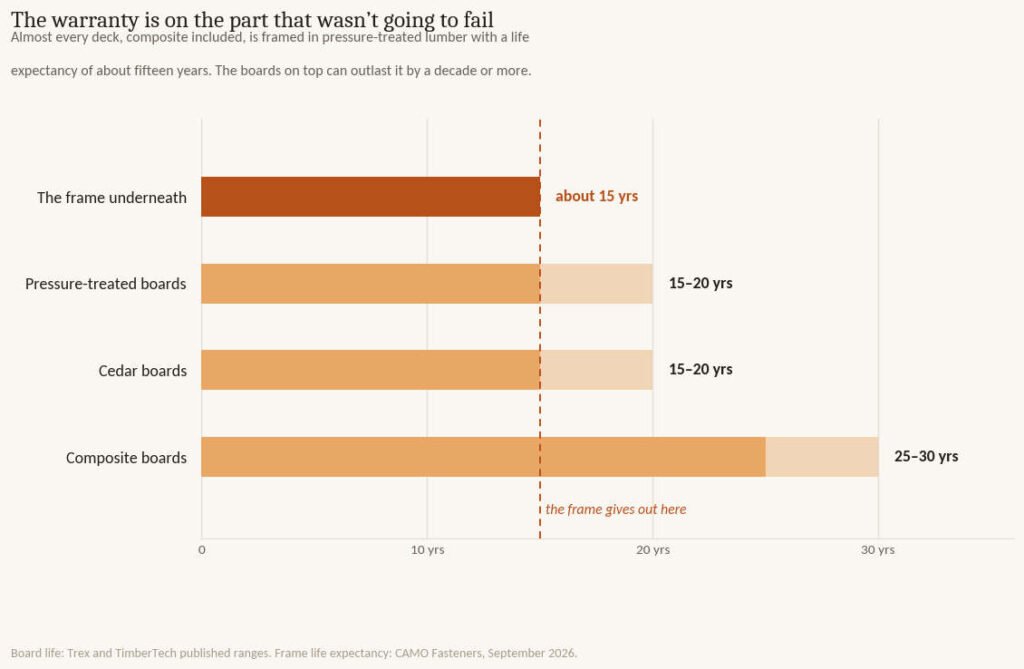
Every deck on this page, composite included, sits on a frame of pressure-treated joists and beams. The boards you walk on are the visible half of the purchase and the cheaper half of the problem.
CAMO, which makes deck fasteners and has no reason to talk the framing down, puts the life expectancy of pressure-treated lumber at around fifteen years. Composite boards carry warranties of 25 to 50 years and a realistic service life of 25 to 30. The two numbers do not match, and the gap is where the money goes.
Trex names the failure point precisely: the ledger board, the piece that bolts the deck to the house. It is the least ventilated part of the structure, it is where water collects, and it is the one component whose failure is not a repair job.
The practical consequence is that a composite deck built on an ordinary frame is a 27-year surface on a 15-year foundation. Somewhere around year fifteen to eighteen, the boards are fine and the thing holding them up is not, and the choice becomes pulling up perfectly good composite to replace the joists underneath or living with a frame past its stated life.
This is the point where the advice stops being about budget. A deck frame is structural, its failure mode is sudden, and inspecting one properly is a job for someone who does it for a living. If your deck is past ten years old, particularly where it meets the house, have it looked at by a licensed contractor rather than by yourself with a screwdriver.
Where to spend the money instead
If you are building new, the cheapest meaningful upgrade is not the decking. It is the tape.
Joist tape is a self-adhesive butyl strip run along the top of every joist before the boards go down, and it stops water sitting in the gap between the board and the framing, which is precisely where rot starts. CAMO’s version carries a 20-year warranty and the material adds, in their words, a few dollars to the project. Against a $4,800 decision about deck boards, it is not a close call about which one buys more years.
Two more worth the money at build time: proper flashing where the ledger meets the house, and hardware rated for contact with modern treated lumber, which is corrosive to ordinary fasteners. None of these are visible when the deck is finished, which is exactly why they get cut.
What each material costs to build
| Material | Installed cost | 320 sq ft | Board life |
|---|---|---|---|
| Pressure-treated pine | $25–$50 / sq ft | $8,000–$16,000 | 15–20 yrs |
| Redwood | $28–$54 / sq ft | $8,960–$17,280 | Varies by grade |
| Cedar | $30–$47 / sq ft | $9,600–$15,040 | 15–20 yrs |
| Composite | $40–$80 / sq ft | $12,800–$25,600 | 25–30 yrs |
| Ipe and tropical hardwood | $50–$70 / sq ft | $16,000–$22,400 | 25+ yrs |
US installed costs, September 2026. Labor is roughly $11 to $22 per square foot of these figures.
Notice how far each range runs. A high-end pressure-treated deck costs more than a cheap composite one, which means the material name on the quote tells you less about the price than the height of the deck, the shape of it and how many stairs it needs. Stairs alone run $1,400 to $2,600 installed.
Permits are the one line where the published sources disagree sharply. HomeGuide puts them at $50 to $150 and Angi at $230 to $500. That is a real spread rather than a mistake, because deck permit fees are set locally and often scale with the value of the work. Call your building department before you budget a number, and do pull the permit, because an unpermitted deck surfaces during a sale.
Where this advice doesn’t apply
Full sun and heavy rain shorten every interval here. A south-facing deck with no tree cover needs staining on the two-year cycle rather than the three-year one, and that is the case where composite closes the gap fastest. A shaded deck in a dry climate can stretch past three years.
Small decks change the arithmetic because the fixed costs do not shrink. On a 100 square foot deck the labor to set up, wash, and stain is not a third of the labor for a 320 square foot one, so the per-square-foot figures overstate the saving from going smaller.
If you are selling within five years, none of the lifecycle reasoning applies to you. Buy on appearance, keep the maintenance current so the deck shows well, and let the next owner meet the frame.
And in a rental, pressure-treated pine with a clear seal is the sensible answer at any budget. Composite is a decision about the next twenty-five years, which is not a horizon a tenancy has.
Questions people ask about deck costs
Is composite decking worth the extra cost?
Over ten years, on cost alone, no. A 320 square foot composite deck runs about $13,100 all in against $10,400 for pressure-treated pine with professional staining every three years, and about $8,720 if you stain it yourself. Composite gets ahead somewhere around year twenty, assuming the frame underneath lasts that long. What it buys before then is time rather than money, and that is a legitimate reason to choose it.
How often does a wood deck need to be stained?
Every two to three years for a stain, and every one to two years for a sealer on pressure-treated lumber. Full sun, heavy rain and foot traffic all push it toward the short end. The cost of waiting too long is not just a shabby deck: a finish that has started to peel has to be stripped first at $2.50 to $5.50 per square foot, which is more than the staining itself.
How long does a deck actually last?
Pressure-treated and cedar boards last 15 to 20 years with maintenance, composite boards 25 to 30. The frame underneath is the number that decides it, and pressure-treated framing has a life expectancy of around fifteen years, with the ledger board where it meets the house failing first. A deck with a sound frame and tired boards is a resurfacing job. A deck with tired framing is a rebuild.
What is the cheapest decking that still lasts?
Pressure-treated pine, sealed on schedule by whoever owns the deck rather than by a contractor. It is the lowest ten-year cost of any option by a clear margin, roughly $8,720 on a 320 square foot deck, and it reaches the same 15 to 20 year board life as cedar at two thirds of the build price. The catch is that the schedule is not optional, and the saving disappears the moment you hire the work out.




Post a comment