
Quartz runs $50 to $150 per square foot installed, granite $40 to $175 and butcher block $35 to $120. On a standard 40 square foot kitchen that is roughly $2,000 to $6,000 for quartz, $1,600 to $7,000 for granite and $1,400 to $4,800 for wood.
Those ranges overlap so heavily that price is not the question that decides this. What ruins each one is. Quartz fails at 150 degrees, granite fails when the seal goes, and butcher block fails at the sink, and none of the three failures appears in the showroom.
What each material costs
| Material | Installed cost | A 40 sq ft kitchen |
|---|---|---|
| Laminate | $25–$50 / sq ft | $1,000–$2,000 |
| Butcher block | $35–$120 / sq ft | $1,400–$4,800 |
| Solid surface | $40–$85 / sq ft | $1,600–$3,400 |
| Granite | $40–$175 / sq ft | $1,600–$7,000 |
| Quartz | $50–$150 / sq ft | $2,000–$6,000 |
| Quartzite | $70–$200 / sq ft | $2,800–$8,000 |
| Marble | $65–$250 / sq ft | $2,600–$10,000 |
US installed costs per square foot, September 2026.
Four things sit inside those installed figures and none of them is the stone.
- Fabrication markup. The finished price runs 1.8 to 3.2 times the slab cost depending on grade. The slab price you were quoted in the yard is not what you are paying for.
- Slab waste. A 40 square foot counter typically consumes around 52 square feet of slab, because the material comes in rectangles and your kitchen does not. You buy roughly a third more stone than you end up with.
- The sink cutout. About $275 for an undermount, for labor and edge finishing.
- The edge profile. A plain eased edge runs about $10 per linear foot, and a typical kitchen has around 22 feet of it. Fancier profiles cost more per foot and add nothing structural.
Installation labor on top of all that lands between $240 and $650 depending on how complicated the layout is. If you are comparing two quotes with a wide gap between them, these four lines are where the difference usually hides rather than in the material itself.
Quartz, and the number that isn’t on the brochure
Quartz is not solid stone. It is roughly nine parts crushed quartz to one part polymer resin, and the resin is what makes it non-porous, which is the whole reason it never needs sealing. The resin is also what fails.
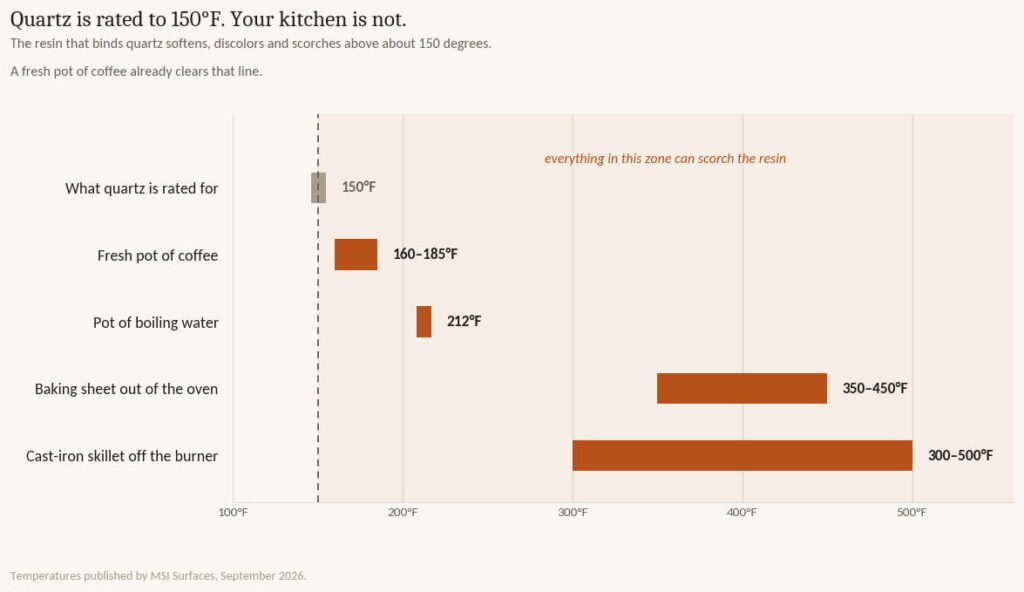
MSI, one of the larger quartz suppliers, puts the safe surface temperature at about 150 degrees Fahrenheit. Above that, the resin can soften, discolor and scorch. Set that number against what actually lands on a kitchen counter and the problem is obvious: a pot of boiling water is 212 degrees, a baking sheet out of the oven is 350 to 450, and a cast-iron skillet off the burner is 300 to 500. Even a fresh pot of coffee, at 160 to 185, is over the line.
There is a second failure worth knowing about. A hot pan meeting a cold surface can produce hairline cracks from thermal shock, which is a different mechanism from scorching and happens faster.
The reason this matters more than it sounds is that the damage is in the binder rather than on a surface coating. A mark on granite can often be polished out because you are working on stone all the way down. A scorch in quartz is a change to the material holding the slab together.
None of which makes quartz a bad counter. It makes the phrase maintenance-free misleading. Quartz asks for one habit rather than a schedule: something goes under anything hot, every time, without exceptions for the pan you are only setting down for a second.
Granite, and the sealing question
Granite is sold with an annual sealing ritual attached to it, and for a good number of slabs that ritual is unnecessary.
Porosity varies enormously between granites. The pale, busy ones absorb quickly: Kashmir White, Colonial White, River White and Dallas White want sealing every six to twelve months. Mid-range slabs go twelve to eighteen months. The dense dark ones, Absolute Black, Uba Tuba and Black Galaxy among them, run two to three years and some of them never need it at all, performing on a water test about as well as quartz does.
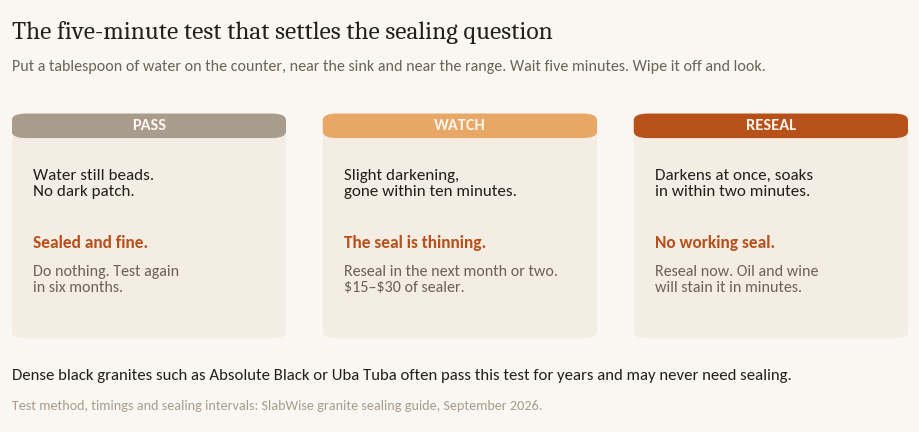
You do not have to guess which one you own. Put a tablespoon of water on the counter, near the sink and again near the range because those two areas wear at different rates, and look at it after five minutes. Water still beading with no dark patch means the seal is intact. A faint darkening that fades within ten minutes means it is thinning and you have a month or two. Darkening straight away, soaking in within a minute or two, means there is no working seal left and oil or red wine will stain it in the time it takes to notice the spill.
Resealing is $15 to $30 of product done yourself, or $100 to $300 to have someone do it. It is a twenty-minute job on a kitchen. The only real cost of granite maintenance is remembering to run the test twice a year.
Butcher block, and the sink
Wood is the cheapest of the three to buy and the only one that asks for attention on a schedule. Well maintained, it clears twenty years comfortably. Badly maintained around a sink, it can be finished in five.
The first year is front-loaded and people abandon it. Oil once a day for a week, once a week for a month, then once a month for the rest of the year. After that it settles down to about four times a year for a counter that is mostly a surface, or monthly if you actually cut on it and it sits near water. The test is the same one as granite in spirit: if water soaks in within thirty seconds rather than beading, it is asking for oil.
The sink cutout is where butcher block dies. Cutting the hole exposes end grain, which wicks water like a straw, and a fabricator who installs the top without sealing those cut edges has built in the failure. Four to six coats of pure tung oil or spar urethane on every cut edge, dried properly between coats, before the top goes down. This is worth asking about by name when you order, because it happens out of sight and you will never know it was skipped until the wood goes black.
The upside is that wood is the only one of the three you can repair yourself. Scratches sand out starting at 120 grit and finishing at 220. Black mildew staining sands out from 80 grit. Even edges that have started to cup can often be brought back by wetting the concave face and weighting it flat overnight. A full sand and re-oil every two to three years brings back most neglected butcher block, and ten years of that costs around $150 in oil and sandpaper, with mineral oil at $8 to $12 a quart.
What ruins each one, in one table
| Material | What ends it | What it asks of you |
|---|---|---|
| Quartz | Heat above about 150°F, and thermal shock from a hot pan on a cold slab | A trivet, every time. No schedule. |
| Granite | Oil and wine, once the seal has worn through | A five-minute water test twice a year; reseal when it fails, $15–$30 DIY |
| Butcher block | Standing water at the sink cutout, through exposed end grain | Oil four times a year, sand and re-oil every 2–3 years, roughly $150 over a decade |
The failure mode of each material, and the habit that prevents it.
So which one
If you cook properly, with cast iron and pans coming off a hot burner, granite. It is the only one of the three that does not care about heat, it costs about the same as quartz, and the maintenance is a test you run twice a year rather than a habit you have to hold every day.
If you want the counter to look identical in fifteen years and you are genuinely disciplined about trivets, quartz. The consistency is real, the stain resistance is real, and the seams are better than granite’s because the material is manufactured rather than quarried.
Butcher block belongs on an island, a baking counter or a run away from the sink, where it is cheap, warm and repairable. Putting it around a sink is choosing the one place it is guaranteed to lose.
And if the budget is genuinely tight, laminate at $25 to $50 per square foot is not an embarrassment. Modern laminate photographs far better than its reputation suggests, and spending $1,500 on counters in a kitchen you plan to redo properly in six years is a defensible decision rather than a compromise. It wants a trivet too, for what it is worth.
Where this advice doesn’t apply
Outdoor kitchens change the ranking completely. Most quartz is not rated for exposure to direct sunlight because ultraviolet light degrades the resin and can fade the color unevenly. Check the specific product before anything goes outside.
Rentals and flips run on different arithmetic, and the answer there is usually laminate or the cheapest granite remnant you can find, because nobody maintaining a property to a schedule is going to oil a wood counter four times a year.
Kitchens with very long unbroken runs deserve a conversation about seams before material. Slabs come in finite sizes, a ten-foot island has a join somewhere, and where that join lands matters more to how the kitchen looks than which of these three materials it is made of.
If the counter is going on old base cabinets, price the cabinets first. Stone tops are heavy, they need level and sound boxes underneath, and it is a poor sequence to buy a $5,000 counter and then discover the cabinets carrying it are the problem.
Questions people ask about countertops
Can you put a hot pan on a quartz countertop?
No. Quartz is rated to roughly 150 degrees Fahrenheit and a pan off the burner is 300 to 500. The resin binding the slab softens and scorches above the limit, and a sudden temperature difference can also cause hairline cracking. The damage sits in the material rather than on a surface coating, so it does not clean or polish off the way a mark on stone can. Use a trivet every time.
How often do granite countertops need sealing?
It depends entirely on the slab. Porous pale granites such as Kashmir White or Colonial White want it every six to twelve months, mid-range slabs every twelve to eighteen, and dense dark ones like Absolute Black or Uba Tuba every two to three years or never. Rather than following a calendar, run the five-minute water test twice a year and reseal when the water starts darkening the stone.
Is butcher block a bad idea near a sink?
Around a sink it is the riskiest of the three, because the cutout exposes end grain that draws water in like a straw. It can be done, but only if every cut edge is sealed with four to six coats of tung oil or spar urethane before installation and the counter is wiped dry after dishes. Neglected, butcher block at a sink can fail inside five years, against twenty-plus elsewhere in the same kitchen.
Why is my countertop quote higher than the price per square foot?
Because the square footage you are billed for is slab, not counter. A 40 square foot kitchen typically consumes about 52 square feet of slab in offcuts, and on top of that sit fabrication markup at 1.8 to 3.2 times the slab cost, roughly $275 for an undermount sink cutout, about $10 per linear foot of edge profile, and $240 to $650 of installation labor. Ask for those lines itemized when you compare bids.




Post a comment