

The standard advice for a dark north-facing room is to paint it a lighter color. It is half right, and the missing half is why so many people follow it and end up with a room that is brighter and still looks cold.
Two separate properties are at work. Light Reflectance Value decides how much light a color returns, and for a low-light room you want 74 or higher on a scale of 0 to 100. Undertone decides what color that light comes back as. Pick a high-LRV color with a cool undertone, which is what most fashionable grays are, and you get a room that reflects plenty of light and reflects it gray.
What north light actually does to a color
North-facing rooms never receive direct sun. The light arriving is indirect skylight, which is cooler and bluer than the direct sunlight a south-facing room gets from dawn to dusk. Farrow & Ball put the consequence simply: northern light brings out the cooler tones within a color.
That is the part people miss. The room is darker, and it is also applying a cool filter to everything in it. A paint that looked like a warm greige on the chip in the store, under warm retail lighting, arrives home and shows you the gray it always had underneath.
Sherwin-Williams gives the same instruction from the other direction: in north-facing rooms, avoid colors with cool undertones, because those cool tones will make the room appear colder. Their own recommendations for the orientation are warm neutrals rather than the brightest whites on the chart.
LRV, and the number to look for
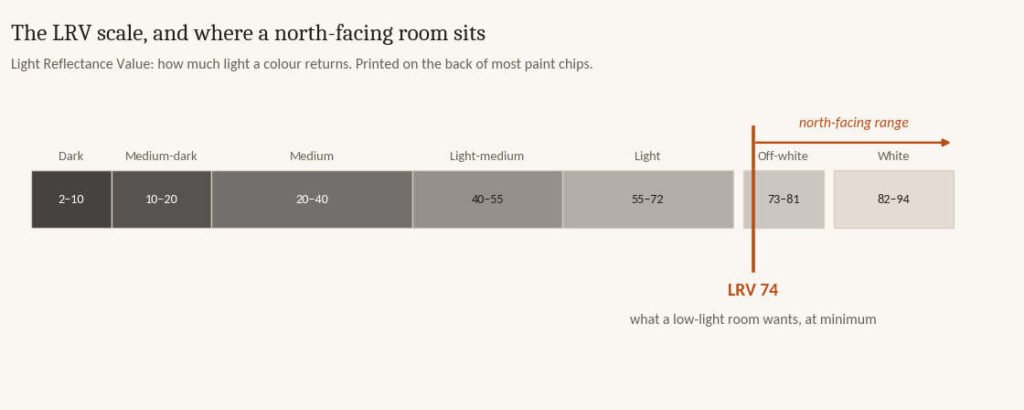
Light Reflectance Value is printed on the back of most paint chips and almost nobody looks at it. It runs from 0, which is a theoretical perfect black, to 100, a theoretical perfect white. Real paints land between about 2 and 94.
| Band | LRV | Where it belongs |
|---|---|---|
| White | 82–94 | Ceilings, trim, north rooms that need everything they can get. |
| Off-white | 73–81 | The working range for a north-facing wall. |
| Light | 55–72 | Fine in a bright room. Starts to go flat in a north one. |
| Light-medium | 40–55 | South and west rooms, or a north room you have decided to make cozy. |
| Medium | 20–40 | Feature walls and rooms with plenty of light. |
| Medium-dark | 10–20 | Deliberate darkness. |
| Dark | 2–10 | Deliberate darkness, committed. |
The LRV bands and what each is realistically for.
For a room with limited natural light the guidance is an LRV of 74 or above, with 55 as an absolute floor. That puts you in the off-white and white bands, which sounds obvious until you check the LRV of the color you were actually considering. A great many popular grays sit in the forties and fifties.
Two dials, not one
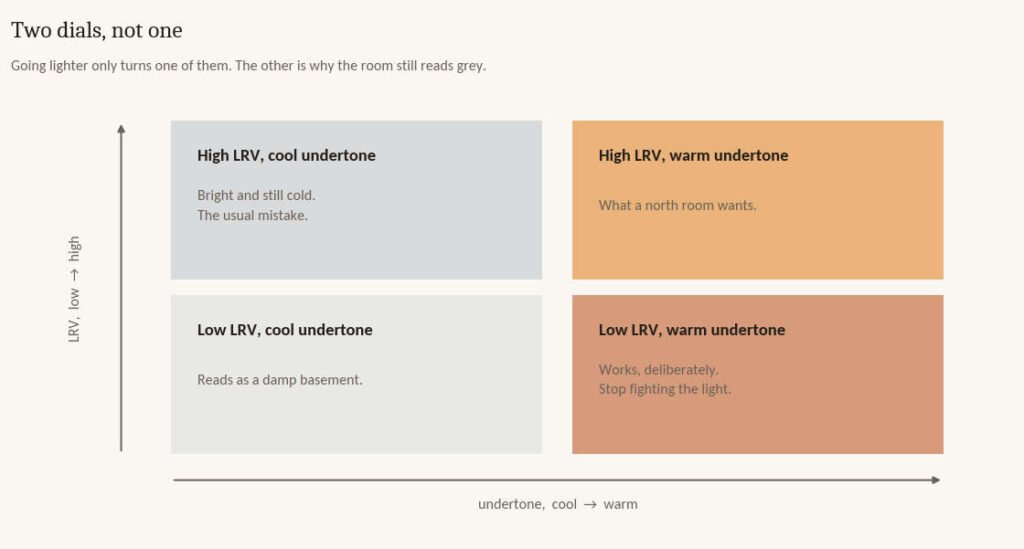
Going lighter turns the LRV dial. It does nothing to the undertone dial, and in a north-facing room the undertone dial is the one doing the damage.
The top-left quadrant is where most disappointed repaints end up. High LRV, cool undertone: a bright, clean, popular gray that reflects a great deal of light and returns every bit of it colder than it went in. The room gets lighter and no warmer, and the owner concludes that north-facing rooms are simply depressing.
The top-right quadrant is the answer. High LRV with a warm undertone means something in the cream, buff or warm-greige family rather than a pure cool white. Sherwin-Williams name Antique White SW 6119, Greek Villa SW 7551 and Worldly Gray SW 7043 for the orientation. Farrow & Ball point at yellow-based colors such as Yellow Ground, New White and White Tie to bounce as much light as possible.
Test it the only way that works. Buy sample pots, paint large patches, and look at them in that room at three in the afternoon in the season you find hardest. A chip held up in a store tells you nothing about how a color behaves under northern light, which is precisely the variable you are trying to solve for.
The order to fix it in, and paint is third
Here is the line that reframes the whole problem, from a color consultant who says it more bluntly than most: a paint color can only reflect light if it is given light.
A north-facing room is short of light before you have picked up a brush. If the room is running at half the lumens it needs, no color on the chart will save it, because there is nothing there to reflect. Painting first is treating the symptom.
- Fix the quantity first. Work out what the room actually needs in lumens and get there. Most rooms are lit to roughly half the recommended level, and a north-facing room is the one where that shortfall is most visible.
- Fix the color temperature second. Cool white bulbs in a room already receiving cool daylight compound the problem. Warmer bulbs pull the room back toward neutral for free.
- Then choose paint. With enough warm light in the room, a much wider range of colors becomes usable, including several that would have read as gray before.
Do it in the other order and you will repaint twice.
The other answer: stop fighting it
There is a second strategy that gets far less airtime, and in some rooms it is the better one. Rather than chasing brightness a north-facing room will never deliver, lean into the low light and paint it something deliberately dark. Farrow & Ball suggest Railings or Down Pipe for exactly this, to create a cozy, cocooning feel.
The reason it works is that the room stops being a failed bright room and becomes a successful dark one. A pale north-facing room reads as gloomy because it is trying and failing to be light. A deep one reads as intentional.
This suits a snug, a study, a dining room used mostly in the evening, or a bedroom. It suits a kitchen far less, because the tasks that happen there need the light. Choose by what the room is for rather than by what color you like.
Where this advice doesn’t apply
South-facing rooms have the opposite problem and take the opposite treatment. Warm light all day means cooler, paler colors work well there, and the warm neutrals recommended above can tip into yellow.
Rooms with large windows on two sides behave differently from their nominal orientation, and a north room with a glazed door and a pale patio outside may be getting far more reflected light than the compass suggests. Observe the actual room before applying a rule about north.
And if the window is shaded by a tree or a neighboring wall, that is a light quantity problem you can sometimes solve with pruning shears for nothing, which is cheaper than any paint.
Check the LRV. Check the undertone. Fix the lighting first. In that order, the room stops being a north-facing problem and becomes a room.
Questions people ask about north-facing rooms
What LRV should I use in a north-facing room?
74 or higher is the working guidance for any room short of natural light, with 55 as the floor. That puts you in the off-white and white bands. The number is printed on the back of the paint chip, and it is worth checking before you fall in love with a color, because a lot of popular grays sit in the forties and will go flat in northern light.
Can you paint a north-facing room gray?
You can, but it has to be a gray with a warm undertone, and most of the fashionable ones are not. A cool gray in a north room compounds the cool light already in it, which is the single most common cause of a repaint. If you want gray, look at greiges with a genuine beige or taupe base and check the LRV is still above 70.
Why does my paint look different at home than in the store?
Store lighting is warm, bright and consistent, and your north-facing room is none of those things. Northern light draws out whatever cool tones a color contains, so a chip that reads as warm under retail lighting can read gray on your wall. The only reliable test is a large painted sample, viewed in the room, at the time of day you use it most.
Should the ceiling be a different white in a north-facing room?
Keep the ceiling at the top of the LRV range, above 82, and match its undertone to the walls rather than defaulting to a cool builder’s white. A cool white ceiling above warm walls introduces the exact contrast you spent the whole exercise trying to avoid, and it is visible in daylight even when nobody can say why the room feels off.




Post a comment