

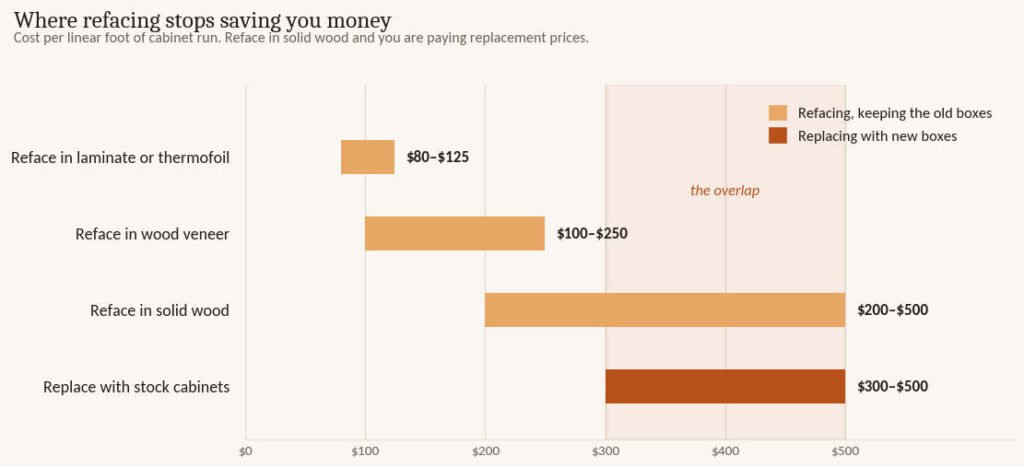
Refacing kitchen cabinets in laminate costs $80 to $125 per linear foot. Refacing the same cabinets in solid wood costs $200 to $500. Replacing them entirely with stock cabinets costs $300 to $500. Those last two ranges overlap almost completely, which means there is a point where you pay replacement money and keep your old boxes.
That point is the whole decision, and it arrives earlier than most people expect. Before any of it matters, though, there are four physical tests worth ten minutes of your time, because refacing sound boxes is a bargain and refacing failing ones is money spent on a problem you still have.
Four tests before you spend anything
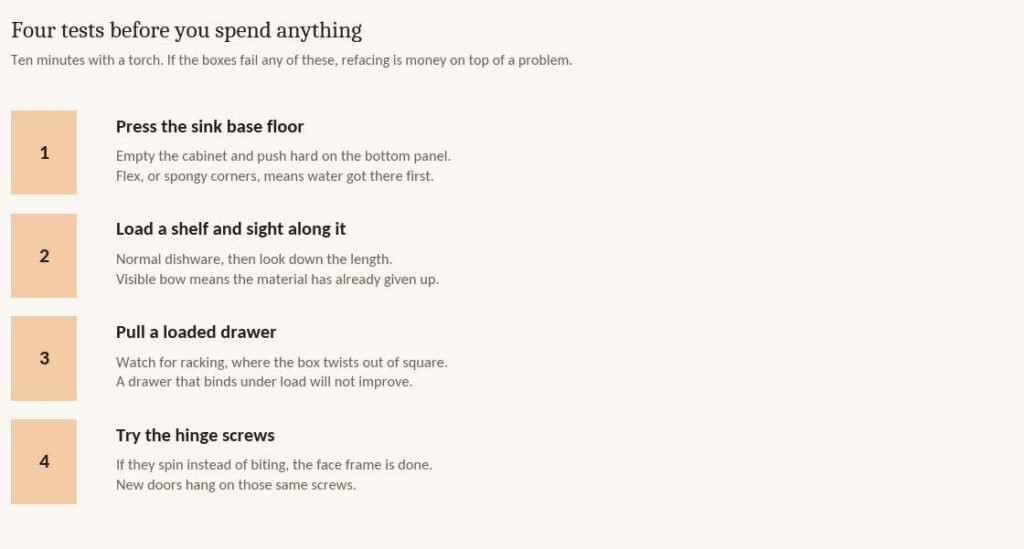
Refacing replaces the doors, drawer fronts and the visible face of the cabinet. Everything structural stays: the boxes, the shelves, the drawer slides, the face frames the new hinges screw into. So the boxes have to be worth keeping, and the only way to know is to go and press on them.
The sink base is where this decision usually gets made. It is the cabinet that has spent twenty years underneath a fitting that drips, and a floor that flexes under hand pressure means water has already been at it. Spongy corners are the same verdict.
The hinge screw test is the one people skip and the one that matters most for refacing specifically, because new doors hang on those same screws. A screw that spins in its hole rather than biting means the face frame has lost its grip, and a fresh door will sag off it exactly as the old one did.
Cabinets built in the 1990s often pass all four of these. Cabinets that have lived under a leaking sink usually fail the first one. If yours fail two or more, the honest answer is that you are looking at replacement and the refacing quote is a distraction.
What each option costs
| Option | Cost | What you get |
|---|---|---|
| Refinishing | $1,500–$4,500 | Same doors, stripped and repainted or restained. Cheapest, and limited to the color changing. |
| Refacing in laminate | $2,000–$4,000 total | New doors and a laminate skin on the frames. Durable, and it does not look like wood. |
| Refacing in wood veneer | $2,500–$8,000 total | New doors and real wood veneer on the frames. The sensible middle. |
| Refacing in solid wood | $5,000–$16,000 total | New solid doors, real wood faces. Handsome, and priced like replacement. |
| Replacing with stock | $4,500–$15,000 | New boxes, new everything. Layout can change. |
| Replacing, semi-custom | $12,000–$30,000 installed | New boxes built to your dimensions. |
Typical figures for an average kitchen of 100 to 200 square feet, September 2026.
The other number worth having is time. Refacing takes two to five days and the kitchen stays usable through most of it. Replacement takes weeks, and the cabinets are only one part of what gets disturbed, because countertops come off with them.
Where the saving disappears
Look at the chart again. Laminate and veneer refacing sit well below the cost of new stock cabinets, and at those prices refacing is straightforwardly good value on sound boxes. Solid wood refacing runs from $200 to $500 per linear foot and new stock cabinets run $300 to $500. The top two thirds of the solid wood range is inside replacement territory.
So the position, stated plainly: reface in laminate or veneer, or replace. Refacing in solid wood is the option that costs replacement money, keeps twenty-year-old boxes, and cannot change a single thing about how the kitchen works. It is the one combination on this page that is hard to justify.
The exception is a kitchen with genuinely good boxes, usually solid plywood construction from a period when that was standard, in a layout that already works. Keeping well-made boxes and putting good doors on them is a legitimate choice. Doing it to particleboard boxes from a builder-grade kitchen is not.
What refacing cannot fix
Refacing changes the visible parts and nothing else. If your complaint is how the kitchen looks, it is the right tool. If your complaint is how the kitchen works, it is the wrong one, and no amount of new doors will change that.
- Not enough drawers, or drawers in the wrong place. The drawer boxes are staying.
- A pantry you cannot reach into, or dead corner cabinets. Same cabinets, same corners.
- Moving the sink, the range or the dishwasher. That is plumbing and layout, which means new cabinets.
- Adding an island, or changing the run of the counter. Replacement.
This is the test people get wrong, because it is easy to convince yourself that a kitchen you dislike has an appearance problem when it has a layout problem. Spend a week noticing what actually annoys you. If the list is mostly about where things are rather than what they look like, refacing will disappoint you at any price.
The resale argument, and how far to trust it
Refacing shows a return of roughly 60 to 75 percent on the money spent, and one industry figure puts cost recovery as high as 112.9 percent against around 50 percent for a major kitchen replacement. Take the high number with some caution, because recovery figures depend heavily on the starting condition and the market, but the direction is consistent across sources: refacing recovers a larger share of a smaller number.
The practical reading is that refacing is the better move if you are selling within a couple of years and the kitchen looks tired rather than broken. Replacement is the better move if you are staying, because the thing you are buying is a kitchen that works rather than a number on a valuation.
Where this advice doesn’t apply
If the kitchen is going to be gutted anyway for other reasons, the cabinet decision is already made. Once the countertops are coming off and the floor is coming up, keeping the old boxes saves less than it appears to and constrains everything else.
Rentals and flips run on different arithmetic. Refinishing at $1,500 to $4,500 is often the right answer there, and refacing rarely is, because the gap between refinished and refaced is not visible in listing photographs.
And if the doors are the only thing you dislike, ask about door replacement alone, which runs $2,200 to $6,600. It is a real option that sits between refinishing and refacing and almost nobody offers it unprompted.
Press on the sink base first. That one test settles more of this decision than any quote will.
Questions people ask about cabinet refacing
Is cabinet refacing worth it?
On sound boxes in a layout that works, yes, particularly in laminate or veneer at $80 to $250 per linear foot against $300 to $500 for new stock cabinets. It stops being worth it in two situations: when the boxes fail the physical tests, and when you have specified solid wood, at which point you are inside replacement pricing with none of the benefits.
How long does cabinet refacing take?
Two to five days for an average kitchen, against several weeks for replacement. The kitchen stays broadly usable throughout, which for a household that cooks is worth real money in avoided takeout and frustration. It is the single strongest practical argument for refacing over replacement.
Can you reface cabinets yourself?
Doors and hardware, yes. The veneer or laminate work on the face frames is where DIY refacing goes wrong, because it is unforgiving work on a surface that sits at eye level in good light. A halfway outcome looks worse than the original kitchen, and the materials are not cheap enough to treat as practice.
What is the difference between refacing and refinishing?
Refinishing keeps your existing doors and changes their color, by stripping and repainting or restaining, at $1,500 to $4,500. Refacing replaces the doors and drawer fronts entirely and puts a new skin on the cabinet faces, at $2,000 to $16,000 depending on material. Refinishing cannot change the door style; refacing can.




Post a comment