
A standard 32-inch interior door gives you about 30 inches of clear opening once the slab and the stop are in the way. A typical three-seat sofa needs 33. That gap of three inches is the reason sofas end up wedged in hallways, and it is entirely predictable before you buy.
The number that has to clear the door is not the depth on the product page. It is the diagonal depth, measured across the frame with the cushions off, and on most three-seat sofas it lands between 31 and 37 inches. Here is how to measure it, what your doors actually give you, and what it costs if you get it wrong.
How do you measure the diagonal depth of a sofa?
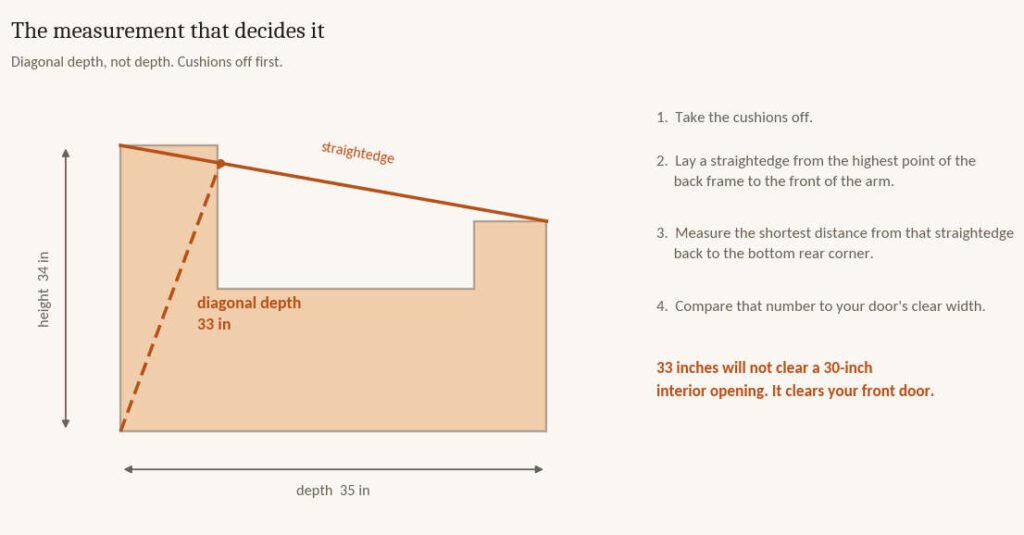
Furniture retailers all publish the same method, and it takes about a minute. Pull the cushions off. Lay a straightedge from the highest point of the back frame to the front of the arm. Then measure the shortest distance from that straightedge back to the bottom rear corner of the sofa. That distance is the diagonal depth, and it is what has to clear your door.
It works because a sofa does not go through a doorway square. It goes through tilted, resting on that diagonal, which is why the depth printed on the listing is close to irrelevant. On the sofa in the drawing, the depth is 35 inches and the diagonal depth is 33.
Both retailers I checked add the same disclaimer, and it is worth repeating: measuring this correctly does not guarantee the sofa gets in. It only tells you whether it is geometrically possible.
What your doors actually measure
A 32-inch door is not a 32-inch opening. The number on the door is the width of the slab, and when the door is open the slab, the hinges and the stop all sit in the gap. Interior doors are 1⅜ inches thick and exterior doors 1¾, so the usable opening is roughly an inch and a half to two inches narrower than the name.
| Door | Nominal width | Roughly clear | Where you find it |
|---|---|---|---|
| Closet | 24 in | 22 in | Closets, small utility |
| Bathroom | 28–30 in | 26–28 in | Bathrooms, small bedrooms |
| Bedroom | 30 in | 28 in | Most bedrooms |
| Main passage | 32–36 in | 30–34 in | Hallways, living rooms |
| Front door | 36 in | 34 in | Standard US exterior door |
Standard residential door widths, and the opening you actually get.
That last row is the useful one. Your front door is almost certainly the widest opening in the house, and a sofa that will not pass an interior bedroom door will usually walk straight through the front.
Diagonal depth by sofa size
Three-seat sofas run 71 to 86 inches wide, 32 to 40 deep and 26 to 36 tall, with 84 by 35 being the most common combination sold. Run those through the measurement above and the diagonal depth lands where you would expect.
| Sofa depth × height | Typical arm height | Diagonal depth |
|---|---|---|
| 32 × 32 in | 24 in | 31 in |
| 35 × 34 in (most common) | 25 in | 33 in |
| 36 × 35 in | 26 in | 34 in |
| 38 × 36 in | 26 in | 35 in |
| 40 × 38 in | 28 in | 37 in |
Diagonal depth calculated from the frame geometry. Measure your own sofa; these are indicative.
Compare that column against the door table and the picture is blunt. Almost nothing in the three-seat category clears a 28-inch bedroom door. Most of it clears a 34-inch front door. The common failure is not the front of the house; it is the second door, the turn at the top of the stairs, or the hallway with a radiator in it.
Loveseats are the quiet answer to a lot of this. At 48 to 72 inches wide they are shorter, but the depth and height are usually identical to a full sofa, so the diagonal depth barely changes. A loveseat solves a narrow hallway problem and does nothing for a narrow door.
What to do when the number doesn’t work
Three inches short is not the end of the purchase. In rough order of how much trouble each one is:
- Take the door off its hinges. This is the one nobody tries first and it is the one that usually works. Removing the slab gives back the slab thickness and the swing clearance, which is close to two inches on an interior door. Two inches is frequently the entire problem.
- Take the legs off. Most sofa legs unscrew, and they are usually between three and six inches. This changes the height, which changes the diagonal depth.
- Use a different door. The front door is wider than everything else. Coming in through a patio slider or a French door, if you have one, is wider still.
- Buy a knock-down or modular sofa. These ship in pieces and assemble in the room, which sidesteps the geometry entirely. If your access is genuinely tight, this is the decision to make at the point of purchase, not after.
- Hoist it through a window. This is what movers do when a brownstone staircase makes the answer no. It is quoted case by case rather than at a list price, and it is the point at which the sofa has become an expensive decision.
The costs nobody quotes you
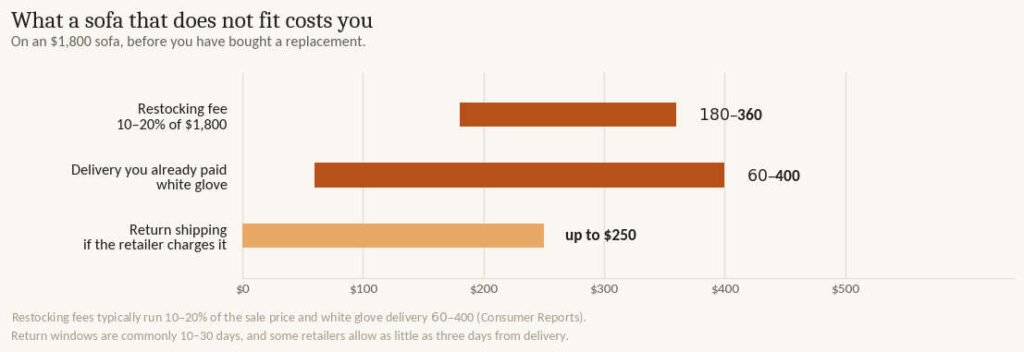
White glove delivery, meaning into the room with assembly and packaging removed, runs $60 to $400 depending on retailer and distance. Restoration Hardware charges a flat rate starting at $199 within 50 miles. Ethan Allen starts at $59 for orders up to $499. That is the money you have already spent when the sofa arrives at a door it will not fit through.
Then the return. Restocking fees typically run 10 to 20 percent of the sale price. On an $1,800 sofa that is $180 to $360, and some retailers add a further percentage for late returns. Badcock charges 20 percent on anything sent back between day 11 and day 30.
The window is tighter than people assume. Ten to thirty days is standard. IKEA gives you 180 days with proof of purchase. Bob’s Discount Furniture gives you three days from delivery. If you accept a sofa on a Friday, discover the problem on Monday and call on Tuesday, at some retailers you are already outside the policy.
So the realistic cost of a sofa that does not fit is somewhere between $240 and $760 before you have bought a replacement, and that assumes the retailer takes it back at all.
One number worth knowing on the other side of this: Consumer Reports found only 6 percent of in-store furniture purchases and 10 percent of online ones arrive damaged or missing parts. Delivery is mostly reliable. Fit is the part that goes wrong.
How much space should you leave around a sofa?
A sofa that gets into the room and then dominates it is a different kind of mistake, and the numbers for avoiding it are simple. Leave at least 30 inches of walking room in front of the sofa. Leave 12 to 18 inches between the sofa and the coffee table, which is close enough to reach a cup and far enough to get past.
Seat height is the one people forget to check and then live with. Most sofas sit 15 to 20 inches off the floor, with 17 to 18 being standard. Below 16 inches a sofa is noticeably harder to get out of, which matters more every year you own it. Seat depth runs 20 to 25 inches; at the deep end you either have tall occupants or you are buying cushions to fill the gap behind your back.
Where this advice doesn’t apply
If you live in a new build with 36-inch main passages throughout, most of this is academic and you can buy on looks. The measuring matters in older housing, in apartments, and anywhere with a turn at the top of a staircase.
Sectionals are a separate problem and this method does not solve them. At 94 to 156 inches wide they arrive in pieces by design, so the question is not whether the sectional fits but whether each individual piece does. Ask the retailer for the dimensions of the largest single section, not the assembled measurement.
And if you are buying secondhand, none of the retailer protections above exist. There is no restocking fee because there is no return. Measure before you hand over the money, not after it is in the van.
Five minutes with a tape measure and a straightedge is the whole job. It is the cheapest insurance in furniture buying and almost nobody does it.
Questions people ask about sofa measurements
Can you take the door off to get a sofa in?
Yes, and it is usually the first thing to try. Lifting an interior door off its hinges gives back roughly two inches of clear width, because you remove both the slab thickness and the space the open door occupies. Most interior doors lift straight off once the hinge pins are tapped out, and it takes about five minutes per door.
Does a sofa go through a doorway on its side or upright?
Upright and tilted, in almost every case. Standing a sofa on its end and walking it through is what the diagonal depth measurement describes, and it is why a 35-inch-deep sofa can pass an opening narrower than 35 inches. Carrying it flat on its side needs the full width of the sofa to clear the door height, which is rarely possible with anything over 80 inches wide.
What size sofa fits through a 30-inch door?
A 30-inch door gives about 28 inches of clear opening, which rules out most three-seat sofas at 31 to 37 inches of diagonal depth. Take the door off and you have roughly 30 inches to work with, which brings the smallest end of the range into play. For a genuinely narrow opening, a knock-down or modular sofa that assembles in the room is a more reliable answer than hunting for a slim enough frame.
Should I measure before or after ordering?
Before, and it is not close. Return windows run as short as three days from delivery at some retailers, restocking fees reach 20 percent, and the delivery charge you already paid is not usually refunded. Measuring costs five minutes; finding out after delivery costs several hundred dollars.




Post a comment