
A living room almost always needs an 8 × 10 at minimum, and usually a 9 × 12. The 5 × 7 that most people buy is 35 square feet against the 108 that room actually wants, and it is the single most common decorating mistake in an American living room.
The reason it sells is not that anyone thinks it looks better. It is that a 9 × 12 is three times the rug and roughly three times the price, and the 5 × 7 is the cheapest thing on the shelf that still counts as an area rug. Here are the sizes each room needs, the rules behind them, and what to do if you already own one that is too small.
The rule, and why a small rug breaks it
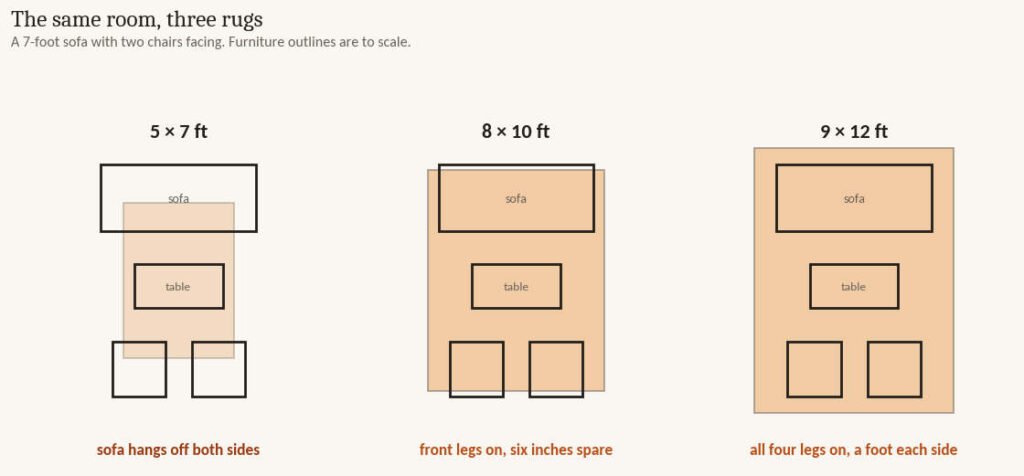
The rule designers work to is simple: every piece of seating should have at least its front two legs on the rug, and ideally all four. A rug is there to draw a boundary around the conversation. Furniture standing outside that boundary looks like it wandered off.
Emily Henderson puts the minimum bluntly. Living rooms almost always need at least an 8 × 10, often a 9 × 12, and nothing below a 6 × 9 belongs in one. On a 4 × 6 her advice is one word: don’t.
The arithmetic is easy to check with a tape measure. A standard sofa is about seven feet long. For the rug to show a foot of itself either side of that sofa, it has to be nine feet wide. An 8 × 10 gives you six inches each side, which works but looks tight. Anything narrower and the sofa hangs off both ends, which is what the left-hand plan above shows.
One thing matters more than the rule itself: consistency. A sofa fully on the rug with the armchairs entirely off is worse than having everything off, because the eye reads the mismatch as a mistake rather than a choice.
Living room: what size for what room
| Room size | Rug size | Notes |
|---|---|---|
| Up to 10 × 12 ft | 6 × 9 | Only with the sofa against a wall and the rug floated in front of it. |
| 12 × 15 ft | 8 × 10 | The workable minimum for a standard seating group. |
| 13 × 17 ft | 9 × 12 | The size most living rooms should have bought in the first place. |
| 15 × 20 ft or larger | 10 × 14 or 12 × 15 | Large seating groups, sectionals, open-plan rooms. |
Leave at least 12 inches of bare floor between the rug and the walls.
That last line is the other half of the rule and the reason bigger is not always better. A rug that runs almost to the baseboard reads as badly fitted wall-to-wall carpet, and it removes the frame of floor that makes a rug look deliberate.
Dining room: the 24-inch rule
This is the one room where rug size is a functional question rather than an aesthetic one. The rug has to extend at least 24 inches beyond every edge of the table, because that is roughly how far a chair travels when someone pushes back to stand up. Get it wrong and the back legs drop off the rug edge every time anyone leaves the table, which is both irritating and a genuine way to tip a chair.
| Table | Rug size | Seats |
|---|---|---|
| Up to 60 in long | 8 × 10 | Four |
| 72–84 in long | 9 × 12 | Six. The most common dining room size. |
| 90–108 in long | 10 × 14 | Eight, or a room used for entertaining. |
| Round, 48 in diameter | 8 ft round | Add 48 in to the table diameter. |
Rug sizes for dining tables, sized so chairs stay on the rug when pulled out.
Round tables follow the same logic with easier arithmetic. Add 48 inches to the diameter of the table, which gives you 24 inches of clearance all the way round.
Bedroom: 18 to 24 inches on each side
In a bedroom the measurement that matters is how much rug your feet land on when you get out of bed. Aim for 18 to 24 inches of rug showing along each side of the bed and past the foot. The rug goes under the bed, starting below the nightstands or just in front of them, not floating at the foot.
| Bed | Rug size | Notes |
|---|---|---|
| Twin | 3 × 5 to 5 × 8 | A single runner down one side often does more. |
| Full | 5 × 8 to 8 × 10 | 8 × 10 if the room allows it. |
| Queen | 6 × 9 to 8 × 10 | 8 × 10 is the size that gets the margins right. |
| King | 8 × 10 to 10 × 14 | 9 × 12 is the sensible default. |
Bedroom rug sizes by bed. The margin matters more than the size on the label.
There is a cheaper answer that works better than a too-small rug, and almost nobody mentions it because nobody sells it. Two runners, one down each side of the bed, cover the floor your feet actually use and cost a fraction of a 9 × 12. It is not the magazine look, but it beats a 5 × 7 stranded at the foot of a king bed.
Why the small rug is the one people buy
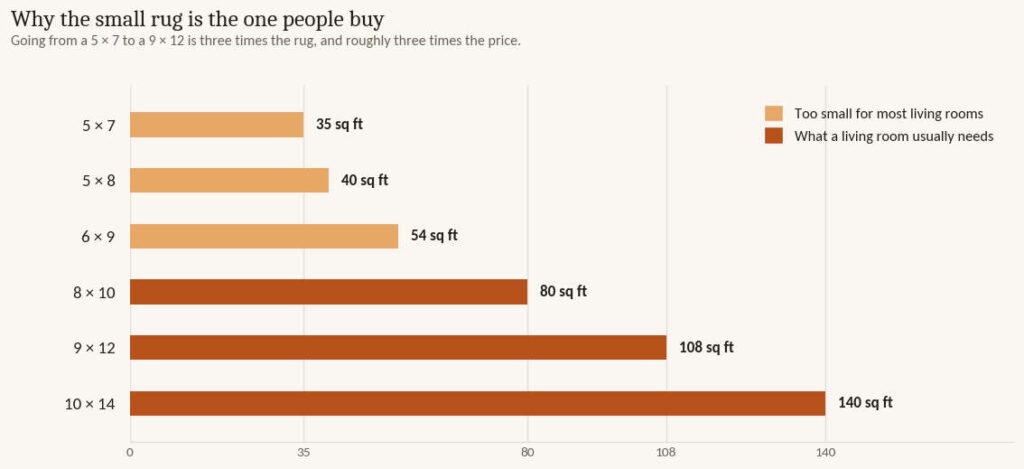
Rugs are priced by area, and area grows quickly. A 5 × 7 is 35 square feet. An 8 × 10 is 80. A 9 × 12 is 108. Moving from the small rug to the right one is three times the material, and the price follows.
At 8 × 10, a machine-made synthetic runs roughly $100 to $300. Mid-range, where most people end up, is $300 to $800. Wool blends and hand-tufted construction start around $800 and climb past $2,500. The practical sweet spot most buyers land in is $200 to $500.
So the honest explanation for why living rooms are full of undersized rugs is not ignorance. It is that the correct rug costs two to three times more than the one beside it on the shelf, and the shelf is stocked with what sells. That is worth knowing before you decide the small one will probably be fine.
If the budget genuinely will not stretch, buy the largest natural-fiber rug you can afford rather than a small version of the one you wanted. A big jute rug at $250 does more for a room than a small wool one at the same price.
If you already own a rug that’s too small
Do not push the furniture back against the walls to make the rug look proportionate. That shrinks the room and makes the seating arrangement worse in order to flatter a rug.
- Layer it over a larger natural-fiber rug. A big sisal or jute underneath costs relatively little, gives you the footprint you needed, and the smaller rug becomes the pattern on top. This is the standard designer fix and it works.
- Move it somewhere its size is right. Beside a bed, in an entry, under a desk, or in a genuinely small room where the sofa sits against a wall.
- Use it in a bedroom as one of a pair, one down each side of the bed, if the proportions happen to suit.
Where this advice doesn’t apply
Small apartment living rooms are the real exception. If the sofa has to sit against a wall, a 6 × 9 floated in front of it is a legitimate arrangement rather than a compromise, and forcing a 9 × 12 into a room that cannot hold it makes things worse.
Hides and other irregular rugs are exempt from all of this. They are sculptural objects rather than area rugs, and the leg rule does not describe what they are doing.
And if the floor underneath is wall-to-wall carpet, this is a different problem with different rules. A rug over carpet needs a pad made for that purpose or it will ripple and creep, and the sizing conversation comes second to solving that.
Measure the room, measure the sofa, and buy the size those two numbers point to. It is the one decorating decision where the correct answer is arithmetic rather than taste.
Questions people ask about rug size
Can a rug be too big for a room?
Yes, and the threshold is clearer than most design rules. Leave at least 12 inches of bare floor between the rug and the walls. Below that the rug stops reading as a rug and starts reading as fitted carpet that somebody cut badly, and you lose the border of floor that frames the whole arrangement. In a small room, going right to the walls also makes the space feel smaller rather than larger.
Is it cheaper to buy two small rugs instead of one large one?
The arithmetic says yes and the result says no. Two 5 × 8 rugs give you 80 square feet, the same as a single 8 × 10, usually for less money. But two rugs butted together leave a seam that no amount of arranging hides, they shift apart underfoot, and the eye reads two objects rather than one boundary. The layering approach is different and does work: a small rug centered on a much larger plain one looks deliberate because it is.
What size rug goes under a sectional?
Bigger than you think, because sectionals run from 94 to 156 inches along their longest side. A 9 × 12 is the realistic minimum and a 10 × 14 is often the right answer. Apply the same leg rule: the front legs of every section on the rug, including the chaise, which is the part people forget because it sits furthest from the middle of the room.
What size rug works in a small apartment living room?
A 6 × 9, with the sofa against the wall and the rug floating in front of it rather than under the sofa’s front legs. This is the one arrangement where the standard rule is worth breaking, because a room under about 10 by 12 feet cannot hold an 8 × 10 with enough floor showing around it. Keep the 12-inch margin to the walls and let the sofa sit just off the rug’s edge.




Post a comment