
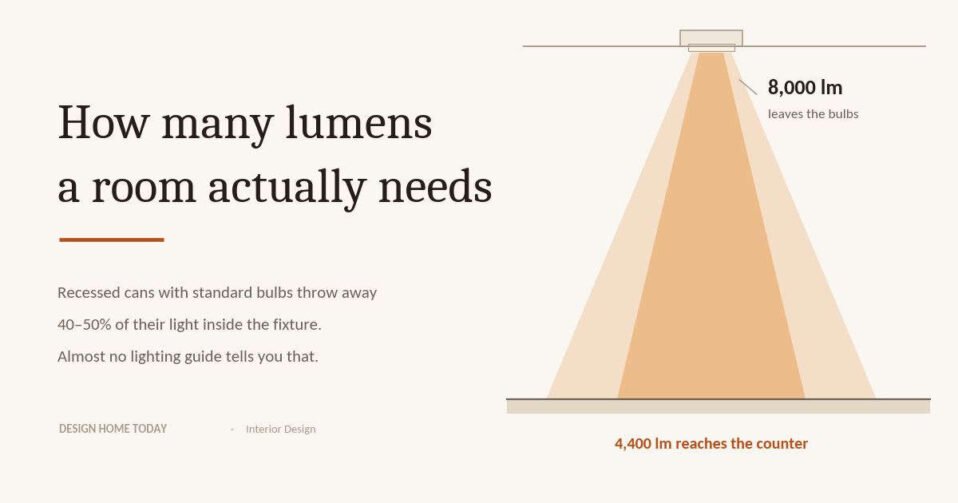
A 12 by 16 foot living room needs roughly 2,900 lumens of general light. Install exactly that, and the room will still feel dim.
The number isn’t wrong. It’s incomplete. Almost every lighting guide online runs the same calculation, floor area multiplied by recommended footcandles, and stops there, as though every lumen a bulb produces lands on the floor. It doesn’t. Put those bulbs in recessed cans and the US Department of Energy puts fixture efficiency at 50 to 60 percent, which means roughly half the light never escapes the housing.
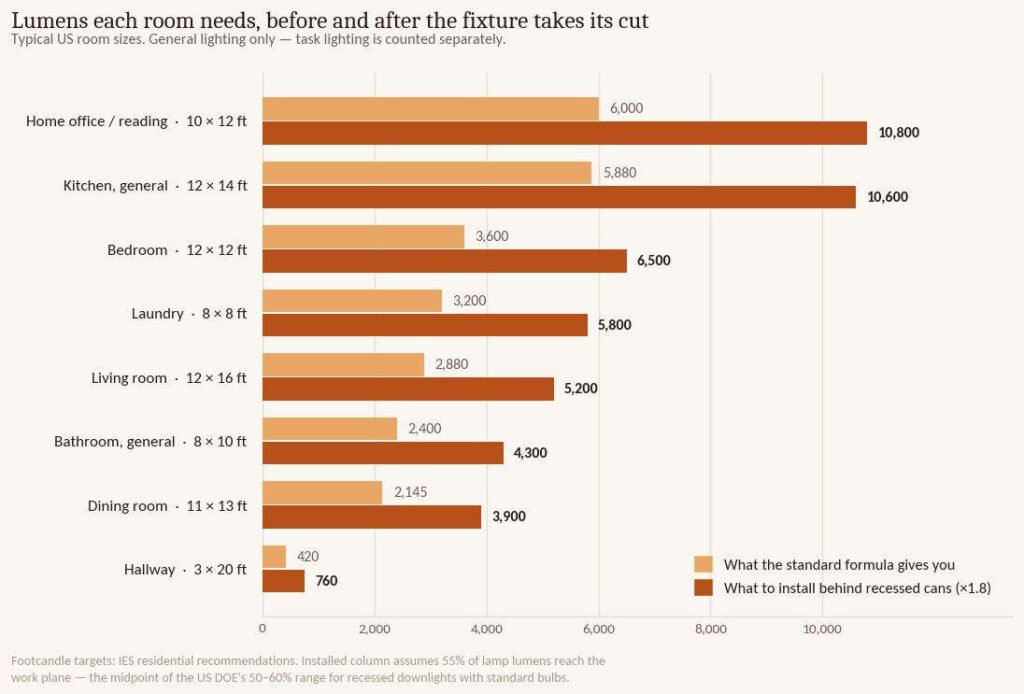
So the honest answer for that living room is closer to 5,200 lumens. Here is the full set of numbers, and the arithmetic behind them.
How many lumens does each room need?
| Room | Size | Footcandles | Lumens that must land | Lumens to install |
|---|---|---|---|---|
| Home office / reading | 10 × 12 ft | 50 | 6,000 | 10,800 |
| Kitchen, general | 12 × 14 ft | 35 | 5,880 | 10,600 |
| Bedroom | 12 × 12 ft | 25 | 3,600 | 6,500 |
| Laundry | 8 × 8 ft | 50 | 3,200 | 5,800 |
| Living room | 12 × 16 ft | 15 | 2,880 | 5,200 |
| Bathroom, general | 8 × 10 ft | 30 | 2,400 | 4,300 |
| Dining room | 11 × 13 ft | 15 | 2,145 | 3,900 |
| Hallway | 3 × 20 ft | 7 | 420 | 760 |
Those footcandle targets come from the Illuminating Engineering Society, the body whose recommended levels most electricians and lighting designers work from. A footcandle is one lumen falling on one square foot of surface. Multiply your floor area by the footcandle target and you have the lumens that need to arrive. Multiply again by 1.8 and you have the lumens you need to buy.
That 1.8 assumes recessed cans. If your fixtures are open, a bare pendant, a drum shade with an open top, a table lamp under a light linen shade, scale it back toward 1.2. There is less housing to trap the light, so less of it is lost.
Why the standard formula comes up short
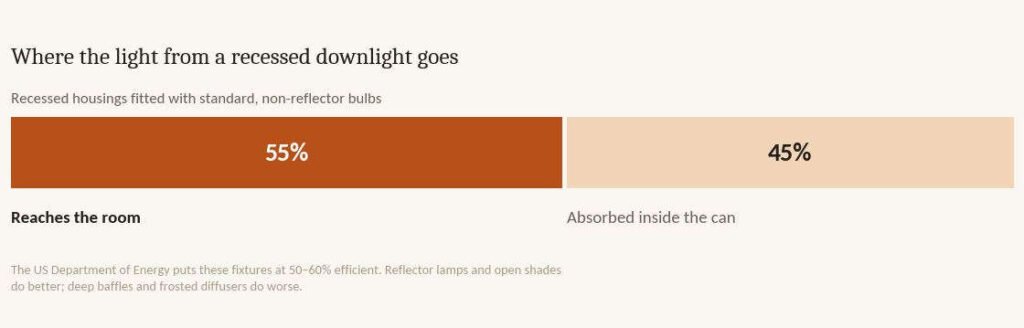
A recessed can is a metal cylinder with a bulb pointing down inside it. Light leaving the bulb sideways or upward hits the housing. Some bounces back out. Much of it becomes heat. The DOE’s 50 to 60 percent figure applies specifically to housings fitted with standard, non-reflector bulbs, which is exactly what most people screw into the cans that came with the house.
There is a second loss nobody mentions. Walls. A room with deep paint, heavy curtains and a walnut floor absorbs light that a pale room bounces back into the space. Two identical fixtures in two identically sized rooms can deliver visibly different results, and no formula on the internet accounts for it.
The useful response to all this is not to buy the brightest bulb on the shelf. It is to stop treating a single ceiling fixture as the entire lighting plan.
Working it out for your own room
General lighting
Take a 12 by 14 foot kitchen. That is 168 square feet.
- General lighting target: 35 footcandles, mid-range for a kitchen. 168 × 35 = 5,880 lumens that need to land on the counters and floor.
- Adjust for the fixtures: 5,880 × 1.8 = about 10,600 lumens to install.
- Divide by fixture output: six-inch LED downlights commonly produce 1,000 to 1,100 lumens each. 10,600 ÷ 1,100 = about 10 cans.
Ten cans in a mid-sized kitchen sounds like a lot until you lay them out and find it is roughly a four-foot grid, which is what a lighting designer would have specified anyway.
Task lighting
Counters need their own supply. IES puts food preparation at 50 to 100 footcandles, so twelve linear feet of counter at two feet deep is 24 square feet at 75 footcandles, or about 1,800 lumens. Undercabinet strips sit inches above the work surface with nothing in the way, so the fixture penalty barely applies. Two thousand lumens of undercabinet lighting covers it.
The multiplier that isn’t on any chart
Eyes age. The lens thickens and yellows, the pupil narrows, and less light reaches the retina. The lighting manufacturer Fagerhult puts the arithmetic plainly: a 40-year-old needs about twice the light of a 20-year-old, and a 60-year-old needs about four times as much.
Four times is not a rounding error. It means a kitchen that reads as comfortably lit to the 35-year-old who designed it can be genuinely difficult for a parent visiting at 70.
Quadrupling every fixture is the wrong answer. It would be expensive, and in a small room with an eight-foot ceiling it would be unpleasant. The better answer is dimmers on the general lighting and generous task light exactly where precision matters: the counter, the stair, the bathroom mirror, the chair someone actually reads in. A dimmer lets the same room serve a 30-year-old at 30 percent and a 70-year-old at full output.
Buy by lumens, not by watts
| Old incandescent | Lumens | LED watts |
|---|---|---|
| 25 W | 375 | 4 W |
| 30 W | 450 | 5 W |
| 60 W | 800 | 9 W |
| 75 W | 1,100 | 12 W |
| 100 W | 1,600 | 17 W |
| 150 W | 2,600 | 27 W |
Wattage measures electricity consumed, not light produced. Asking for a 60-watt bulb made sense when nearly every bulb was incandescent and the relationship held steady. With LEDs it does not. The FTC’s Lighting Facts label, required on bulb packaging, lists brightness in lumens first for precisely this reason.
Two bulbs both sold as 60-watt equivalent can differ by 150 lumens. Read the number, not the equivalence claim on the front of the box.
Buying more lumens is also cheaper than it used to be, which is the part that makes this worth doing properly. The Department of Energy puts LED consumption at up to 90 percent below incandescent, with lifespans up to 25 times longer, and estimates household savings of around $225 a year from the switch. Lighting is roughly 15 percent of a home’s electricity use, so doubling the light in a room no longer means doubling that share of the bill.
When more light is the wrong fix
A room can hit every number above and still feel bad to sit in.
Glare is the usual culprit. A high-output bulb in a shallow fixture on an eight-foot ceiling puts a bright source directly in your eye line, and the room reads as harsh rather than well lit even when the footcandles are correct. Deeper baffles, frosted lenses or simply moving light off the ceiling all fix this, at the cost of some of the output you just calculated for.
The stronger fix is distribution. Three modest sources at different heights, a ceiling fixture, a floor lamp, something on a side table, beat one bright ceiling fixture at the same total lumens every time. The numbers in the table are a budget for the room, not a specification for a single fitting.
Where this advice doesn’t apply
If you rent, recessed cans are off the table and the 1.8 multiplier with them. Lamps carry the load instead. A 1,600-lumen bulb in a well-placed floor lamp delivers more usable light than a brighter ceiling fixture, because almost none of it is wasted in a housing.
If your room has one small north-facing window, quantity is only half the problem. The character of the light matters as much as the amount, and it is a separate calculation.
And if you install everything above but mix warm and cool bulbs across the same room, none of it will look right. Color temperature is its own decision, taken after the quantity is settled.
Get the quantity right first. It is the part you can actually calculate, and the part nearly everyone gets wrong by about half.
Questions people ask about room lighting
How many lumens per square foot does a room need?
Between 7 and 50, depending on what happens in the room. Lumens per square foot is the same measure as footcandles. Hallways need about 7, living and dining rooms 15, bedrooms 25, bathrooms 30, kitchens 35, and desks or reading chairs 50. Those are the levels that must land on the surface, so multiply by 1.8 if the light is coming from recessed cans.
Is 5,000 lumens enough for a living room?
For a living room up to about 180 square feet, yes, if that 5,000 is what the bulbs produce and the fixtures are open. Behind recessed cans it is just short: a 12 by 16 foot room needs about 5,200 installed lumens to deliver the 2,880 that actually reach the floor. For a larger room, or one with dark walls, treat 5,000 as a starting point rather than a finish.
Does ceiling height change how many lumens you need?
Yes. Every calculation here assumes a standard eight-foot ceiling. A ten-foot ceiling puts the fixture two feet further from the surface you are trying to light, and light weakens noticeably over that distance. The fix is more fixtures rather than brighter ones. A single higher-output bulb further away raises glare without raising the level evenly, which is why lighting plans for tall rooms space the fixtures closer together instead of simply upgrading the bulbs.
How many lumens should a bedroom have at night?
Far fewer than the 6,500 in the table. That figure is for the bedroom as a working room, where you get dressed, find things and clean. In the evening the useful number is a bedside lamp at 400 to 800 lumens, which is a 30 to 60 watt incandescent equivalent, with the ceiling light dimmed or off. This is the clearest case for putting the general lighting on a dimmer: one room, two completely different jobs.




Post a comment