
All three of these floors carry warranties measured in decades, and all three fail long before the warranty runs out. They just fail differently. Luxury vinyl plank opens at the seams, usually somewhere between year twelve and year twenty. Engineered wood cups when the humidity leaves the room. Laminate survives everything until the first real leak, and then it is finished.
What links all three is less comfortable: in most houses the floor was killed by the subfloor beneath it or the air around it, not by the plank. The trade body that writes the installation standard asks for a subfloor flat to within 3/16 of an inch over ten feet. Almost nobody measures that, and it decides more about how long the floor lasts than the product you chose.
How long does each floor actually last?
| Floor | Installed cost | What ends it | Typical life | Repairable | Refinishable |
|---|---|---|---|---|---|
| Luxury vinyl plank | $4–$11 / sq ft | Seams open, edges curl | 12–20 yrs at 12 mil | Plank by plank | No |
| Engineered wood | $6–$18 / sq ft | Humidity swings, cupping | 30–40 yrs at 2 mm | Board by board | Only above 1.2 mm |
| Laminate | $3.50–$10 / sq ft | Water, once | Until the first leak | Replace, not repair | No |
Costs are US installed averages as of September 2026. Lifespans assume the floor was installed correctly.
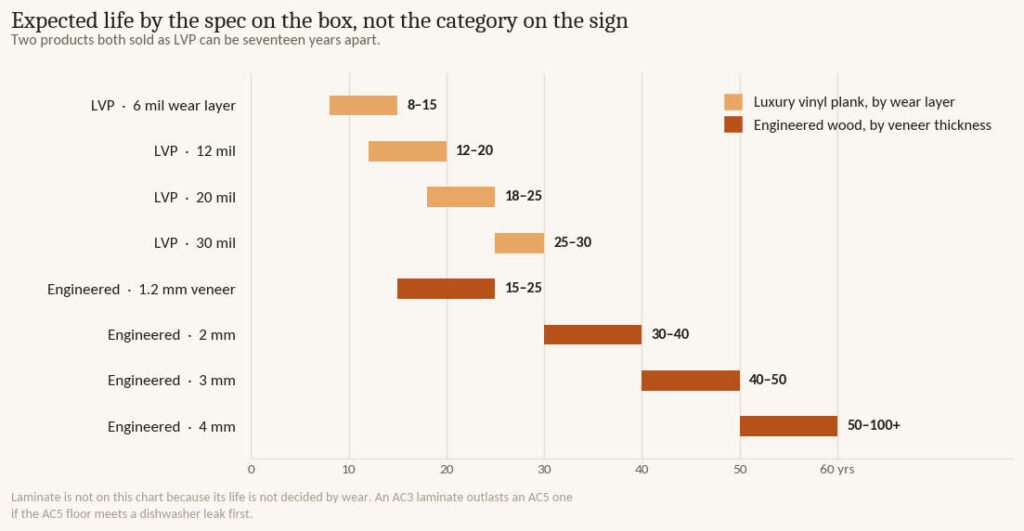
Read the life column with some suspicion. Those are the numbers when everything goes right, and the range inside each category is wider than the gap between categories. A six-mil vinyl plank and a twenty-mil one are both sold as LVP and they are seventeen years apart.
Luxury vinyl plank: the seams open
LVP had an enormous run in 2020 and 2021, which means a very large number of American floors are hitting their fifth year right about now. The complaint that arrives at that age is almost always the same: the planks are pulling apart at the ends.
Some gapping is normal. Under a sixteenth of an inch is seasonal movement and not a fault. Past an eighth of an inch, something is wrong, and it is usually one of three things, none of which is the plank.
- The expansion gap was skipped or undersized. A quarter inch around the entire perimeter is typical. A floating floor that cannot move pushes against itself and the joints give.
- The planks were not acclimated. Forty-eight hours in the room is the usual minimum, and a floor installed the day it came off a cold truck will move after it is locked together.
- The subfloor was not flat. A click joint bridging a dip flexes every time somebody walks on it, and the lock wears until it lets go.
The good news is that LVP is the most forgiving of the three to repair. Planks come up and go back individually if you have matching stock, which is the argument for keeping a box of leftovers in the garage rather than returning it.
The number that decides how long it lasts is the wear layer, quoted in mils. Six mil is a bedroom floor with an eight-to-fifteen-year life. Twelve mil is the standard family specification at twelve to twenty. Twenty mil is what you want with children or a dog, and it runs eighteen to twenty-five. The plank thickness printed in large type on the box matters far less than this number printed in small type on the back.
Engineered wood: the humidity gets it
Engineered wood is the only one of the three with a comfort zone, and the trade literature on its failures reads like a list of things that go wrong when a house gets too dry or too wet. Dry cupping, where the plank edges lift as the wear layer loses moisture and shrinks. Wood shear, where the fibers tear. Glue-line separation, where the layers come apart. Endlift, where board ends curl up off the floor. Telegraphing, where the core pattern appears through the surface.
Different symptoms, largely one cause. The relative humidity in the room went outside what the manufacturer specified, usually because the HVAC could not hold it. Steam mops, wet mopping and non-breathable rugs all appear in the same lists.
That leads to a position worth stating plainly. If your house does not hold humidity — a seasonal cabin, a place that sits empty in winter, a basement — engineered wood is the wrong floor at any budget, and the expensive version will fail the same way the cheap one does.
The veneer thickness trap
Engineered wood is the only floor here that can be sanded and refinished, which is where its long life comes from. Whether yours can is decided by one number nobody advertises.
| Veneer thickness | Refinishes possible | Expected life | In practice |
|---|---|---|---|
| 1.2 mm | None | 15–25 yrs | Builder grade. When it wears, it is over. |
| 2 mm | One light pass | 30–40 yrs | One refinish and you have used it up. |
| 3 mm | Two or three | 40–50 yrs | The sensible target for a floor you keep. |
| 4–4.5 mm | Three to five | 50–100 yrs | Functionally the same as solid wood. |
Each sanding removes roughly 0.5 to 1 mm of wood.
A great deal of what is sold as engineered hardwood in new builds sits at 1.2 mm. It looks identical to the 4 mm product on the showroom floor and it is a fundamentally different purchase: fifteen to twenty-five years, no refinishing, then replacement. If you are paying hardwood prices, ask for the veneer thickness in millimeters before anything else.
One reprieve worth knowing about: a screen-and-recoat refreshes the finish without sanding into the wood, and can add five to ten years to any of them, including the 1.2 mm floors that can never be properly refinished.
Laminate: water, once
Laminate’s core is compressed wood particle. Get it wet and the core swells, the edges lift, and no amount of drying brings the board back. It cannot be repaired. The plank comes out and a new one goes in.
Repairs run an average of about $1,250, with a range from $150 for a damaged edge to $5,000 when the whole floor has to come up. The variable is not how bad the leak was so much as how long it sat before anyone noticed.
This is why the AC rating, which is the spec everyone quotes for laminate, tells you less than you would hope. AC1 through AC5 measure resistance to abrasion. AC3 is the practical minimum for a family home and AC4 suits a busy one. But abrasion is not what kills laminate floors. An AC3 laminate in a dry bedroom outlives an AC5 laminate in a kitchen with a slow dishwasher leak, and the rating had nothing to do with it.
Laminate’s real advantage is price, and it is a genuine one. At $3.50 to $10 installed it is the cheapest way to cover a floor with something that looks like wood. In a bedroom, a home office, or a rental where the budget is the constraint, that is a perfectly sound decision.
The spec that decides more than the product
The National Wood Flooring Association asks for a subfloor flat to within an eighth of an inch over six feet, or three sixteenths over ten feet, unless the manufacturer says otherwise. It also wants expansion space around the perimeter roughly equal to the thickness of the material going down.
Neither of those numbers appears on any product page, and both matter more than the brand. A floating floor is a single connected sheet resting on whatever is underneath it. Where the subfloor dips, the joint spans a void and flexes with every footstep. Click joints are not designed to be hinges. They wear, and then they open, and the homeowner blames the plank.
The practical version: before anyone quotes you for flooring, get a ten-foot straightedge across the room in several directions. If it rocks, the floor needs leveling compound or sanding first, and that is a line item in the quote rather than a surprise. Skipping it does not save money, it defers a larger cost by about five years.
What it costs, and what it costs per year
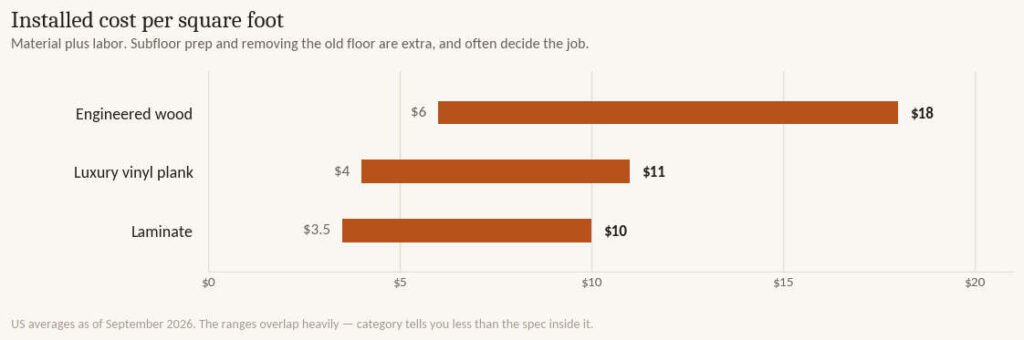
The installed ranges overlap so heavily that the category barely predicts the price. Engineered wood runs $6 to $18 per square foot, LVP $4 to $11, laminate $3.50 to $10. A high-end LVP costs more than a cheap engineered floor.
Divide by expected life and the ordering changes. A twelve-mil LVP at around $7.50 installed, lasting sixteen years, works out near 47 cents per square foot per year. A two-millimeter engineered floor at around $12, lasting thirty-five, comes in around 34 cents. Move to three millimeters and it drops to roughly 27 cents, because the refinishing extends the life without repeating the installation cost.
So engineered wood is the cheaper floor over its life, on one condition: the house has to hold its humidity. If it does not, you are buying the most expensive option and the shortest one at the same time.
Laminate is deliberately absent from that calculation. Its life is not a wear question, so there is no honest number to divide by.
Which floor for which room
- In a basement, on a slab, or anywhere below grade, use LVP. Engineered wood does not belong there and the moisture will find it.
- In a kitchen, LVP at 20 mil. Not laminate, for the reason above, and not 6 mil in a room where chairs get dragged.
- In bedrooms and living rooms, in a house with working climate control, engineered wood at 3 mm or better if the budget reaches. This is where it earns its price.
- In rentals, flips and dry rooms on a tight budget, laminate at AC3 or AC4. Buy spare boxes at the same time, from the same dye lot.
- In bathrooms, none of the three, ideally. Tile, and spend the difference on the subfloor.
- With dogs, 20 mil LVP, and accept that any wood surface will show claw marks within the year.
Where this advice doesn’t apply
Radiant heat changes the rules for all three. Some engineered products and some vinyl are rated for it and some are explicitly not, and installing an unrated floor over a heated slab voids the warranty and usually produces the cupping described above within a season. Check the specific product, not the category.
If you already have solid hardwood in reasonable condition, none of this applies. Refinishing an existing solid floor is cheaper than any option on this page and produces a better result.
And if you are moving in five years, the lifespan arithmetic is mostly irrelevant to you. Buy on appearance and on what a buyer will want to see, and let the next owner worry about year eighteen.
The floor that lasts is rarely the expensive one. It is the one matched to the room it is going in, laid on something flat, in a house that holds its humidity.
Questions people ask about flooring durability
Is LVP really waterproof?
The plank is. The floor is not. Water that reaches the seams runs straight through to the subfloor and sits there, out of sight, where it rots plywood and grows mold exactly as it would under any other floor. Waterproof on the box describes the board’s own resistance to swelling, which is a genuine advantage over laminate, but it is not a promise about the assembly. Wipe up spills at the same speed you would on wood.
Can engineered hardwood go in a basement?
It is the wrong choice in almost every case. Basements sit against ground that holds moisture, and they swing further in relative humidity than the floors above. That is precisely the condition that produces cupping, endlift and glue-line separation in engineered wood. If you want wood underfoot below grade, LVP with a wood-look surface is the honest answer, and if you insist on the real thing, budget for a dehumidifier running year-round.
How long does flooring need to acclimate before installation?
Forty-eight hours in the room where it will be laid is the common minimum for vinyl plank, and many engineered wood manufacturers ask for longer. The boxes need to be open, spread out, and in a room already at the temperature and humidity it will normally sit at. Acclimating in an unheated garage achieves nothing, and a floor installed straight off the delivery truck will move once it is locked together.
Can you install new flooring over existing tile?
Usually yes, and it saves the cost and mess of demolition, but the flatness rule still governs. Tile that has lippage between pieces, or wide grout lines, will telegraph through a floating floor and create exactly the unsupported spans that open click joints. Run a straightedge over it first. Skim-coating the grout lines with leveling compound is a normal part of that job, not an upsell.




Post a comment